


OVERVIEW
Your exercise guide · Power · Fat Loss · Advanced
Overview
Your body type and your goal: what is happening, how your body type reacts, and its pros and cons. Tap a section to open it.
- Body type
- Power
- Goal
- Fat loss
- Level
- Advanced
- Your exact plan
- Exercises, reps, sets, rest and tempo are in your programme and concept video
1. Your Body Type: Power
Your body is built for strength: a wide frame, heavy bones and mostly fast-twitch muscle fibres, the most powerful kind. You carry the most muscle and the largest fuel stores, and you hold on to muscle best of all. You also have the fewest mitochondria, the slowest metabolism and the least insulin-sensitive muscles, so you store fat most easily. Your fibres tire fastest in long sets and recover slowest between them, but your nervous system is the calmest and copes with the longest sessions.
Your strengths
- The highest strength potential
- Builds and keeps muscle readily
- The largest fuel stores
- Usually sociable and patient
Your weaker points
- Stores fat most easily
- The least tolerant of carbohydrate
- Tires fastest in long sets
- High-impact cardio loads the joints
2. Fat Loss: What Is Happening
Losing fat means your body uses more energy than it takes in, so it draws on its fat stores to cover the gap. Exercise helps in three ways: it uses energy; cardio builds more mitochondria, the “power stations” in your muscles where fat is burned; and weight training tells your body to keep its muscle while you are eating less.
The challenge is that when you eat less, your body is tempted to use muscle for fuel as well as fat. Keeping muscle matters, because muscle keeps your metabolism up and gives your body its shape once the fat has gone. So fat loss is really two jobs at once: losing fat, and keeping muscle.
Movement also opens “doors” in your muscles that let sugar in without needing much insulin. Lower insulin lets fat be released from your fat cells to be used as fuel.
3. How Your Body Type Responds to Fat Loss
You are a Power body type trying to lose fat. You hold on to muscle better than any other type, so you can lose fat without losing strength or size. But you have the fewest mitochondria and the least insulin-sensitive muscles, so fat is stored most easily and released most slowly. Short, explosive efforts and heavy lifting suit your fibres and build exactly what your body type lacks.
The pros for your body type
- You keep muscle best of all while eating less.
- You have the biggest fuel stores.
- Your heavy lifts use a lot of energy.
The cons: what to watch
- You store fat most easily.
- You have the fewest mitochondria and the least insulin-sensitive muscles.
- Your joints take more load in high-impact exercise.
KEY POINTS
+ Read more× Close
Your exercise guide · Power · Fat Loss · Advanced
Key points
The most important things to do, each with the reason why. Tap a section to open it.
1. Your Programme This Month
How to lift
- Effort: take every working set to the point where another good rep is not possible.
- Weights: keep them heavy and challenging. Heavy, hard work gives the right hormonal and metabolic response for fat loss.
- Circuits: do the 8 exercises back to back, 15 reps each, with minimal rest between exercises. That is one set. Rest for 2 minutes, then go again: 5 sets in total.
- Technique: before your first session, read the technique advice for the big exercises.
Your week
You have 2 workouts this month, Workout One and Workout Two, both full-body circuits. Each week has 2 or 3 resistance workouts, 3 or 4 cardio sessions and 1 rest day. Your schedule shows which one to do each day. Keep the workouts in order, even if you have to take a day off.
If anything hurts, as opposed to feeling hard, stop and tell us.
2. In Your Workouts
- Watch your concept video before you start each new month. It shows you every exercise and the technique for each one, so every rep is done right from your first session.
- Work to failure, or within a rep of it. The last hard reps are where your muscle gets the strongest signal to change.
- Push the quality of every set. An experienced body needs a bigger challenge to keep changing.
- Lift heavy and with intent. Your large muscles use the most energy per heavy set of any body type, and you keep that muscle best of all.
- Stay active outside the gym. Everyday movement keeps your muscles responsive to insulin: the area your body type needs most help with.
- Find the enjoyment and keep the momentum. Your body type responds best to steady, consistent work over weeks and months, and enjoyment and support are what keep you consistent.
- Aim to beat your last session: one more rep, or a little more weight. Your body only keeps changing while the challenge keeps rising.
3. Your Cardio
- Go all out in every interval: short and explosive. Very short, explosive, all-out efforts suit your fast-twitch fibres and build fat-burning capacity fastest.
- Work at the best steady pace you can hold for the whole lactic acid removal phase. It should not feel easy, but you should be able to keep the pace to the end. Hard, steady work keeps blood flowing fast through your muscles, so lactic acid is cleared and burned as fuel while you keep building fitness, and your second block of intervals is as good as your first.
4. Outside the Gym
- Recover as hard as you train: take your rest days and make sleep a priority. Muscle repairs and gets stronger between workouts, not during them. Your personalised sleep and water recommendations are on your 9 Pillars Lifestyle page.
- Eat around your training as set out in your Nutrition Guide. What you eat before and after training decides your fuel and your recovery.
- Keep a training log, and tell your coach if your performance drops two sessions in a row or anything hurts. Your programme can then be adjusted before small problems become big ones.
5. Before You Start
- Anyone new to exercise, returning after a long break, pregnant, or living with a medical condition or injury should be cleared by their doctor before starting.
- Check with your GP before starting if you have high blood pressure, a heart condition, diabetes, a current injury, are pregnant or have recently given birth, or are returning after illness.
- Stop and seek advice if you feel chest pain or tightness, unusual breathlessness, dizziness or faintness, or sharp joint pain during exercise.
- Tell your coach about any injuries or health conditions so your exercise choices and intensity can be adjusted.
MONTHLY WORKOUT SCHEDULE
Below is our recommended order and number of workouts. Try to stick as close to this as possible. Always keep the order of the workouts the same even if you have to take days off. Ideally do not have more than one day off in a row.
| Day | Session | Day | Session |
|---|---|---|---|
| Day 1 | Cardio | Day 15 | Cardio |
| Day 2 | Workout One | Day 16 | Cardio |
| Day 3 | Cardio | Day 17 | Workout Two |
| Day 4 | Cardio | Day 18 | Cardio |
| Day 5 | Workout Two | Day 19 | Workout One |
| Day 6 | Cardio | Day 20 | Cardio |
| Day 7 | Rest | Day 21 | Rest |
| Day 8 | Workout One | Day 22 | Cardio |
| Day 9 | Cardio | Day 23 | Workout Two |
| Day 10 | Cardio | Day 24 | Cardio |
| Day 11 | Workout Two | Day 25 | Workout One |
| Day 12 | Cardio | Day 26 | Cardio |
| Day 13 | Workout One | Day 27 | Cardio |
| Day 14 | Rest | Day 28 | Rest |
DYNAMIC WARM-UP
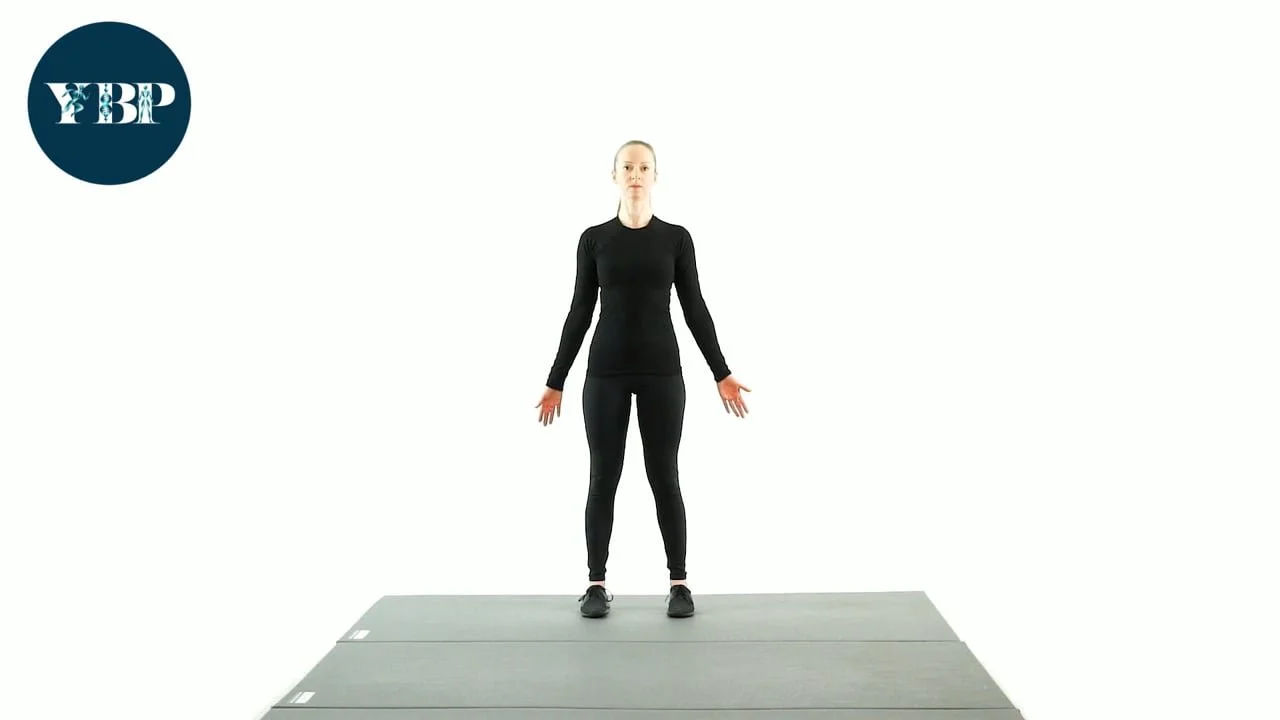
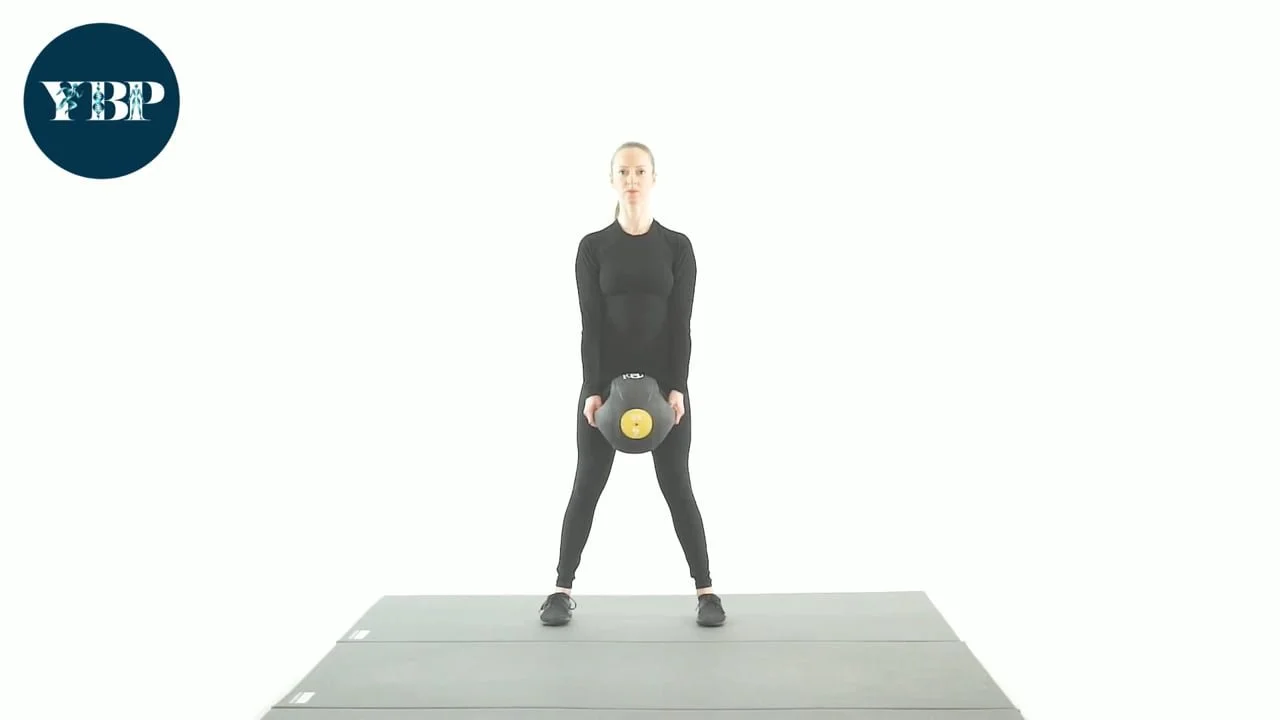
The warm-up is to mobilise and prime your body, it should be specific to the exercise you are about to perform. We recommend 5 mins of gentle cardio to increase body temperature and blood flow to the muscles. Follow this with movements that mimic your exercises but at a slower pace with reduced intensity.
Try our basic warm-up or advanced version with a medicine ball.
RESISTANCE WORKOUT ONE

Workout One Full body
1 circuit of 8 exercises · 15 reps each · 5 sets · every working set to failure · 2 min rest between sets
Block 1 Circuit
5 sets · 8 exercises back to back with minimal rest · 2 min rest between sets
- 1A Lunge — Swiss Ball / Dumbbells · 15 reps
- 1B Aerobic: breakdance · 15 reps
- 1C Press-up — Swiss Ball · 15 reps
- 1D Quad squats — Dumbbells · 15 reps
- 1E Plank — Kettlebell · 15 reps
- 1F Row — Band · 15 reps
- 1G Lunge — Dumbbells · 15 reps
- 1H Aerobic: frog jumps · 15 reps
How the block types work
- Circuit
- Several exercises done back to back with minimal rest between them. One round of all the exercises is one set; then rest.
Keep the weights heavy and challenging to get the right hormonal and metabolic response. The videos for each exercise are below.
Before commencing your workout click here for technique advice on some of the big exercises.
Block 1: Circuit · 8 exercises, 15 reps each · 5 sets, 2 min rest
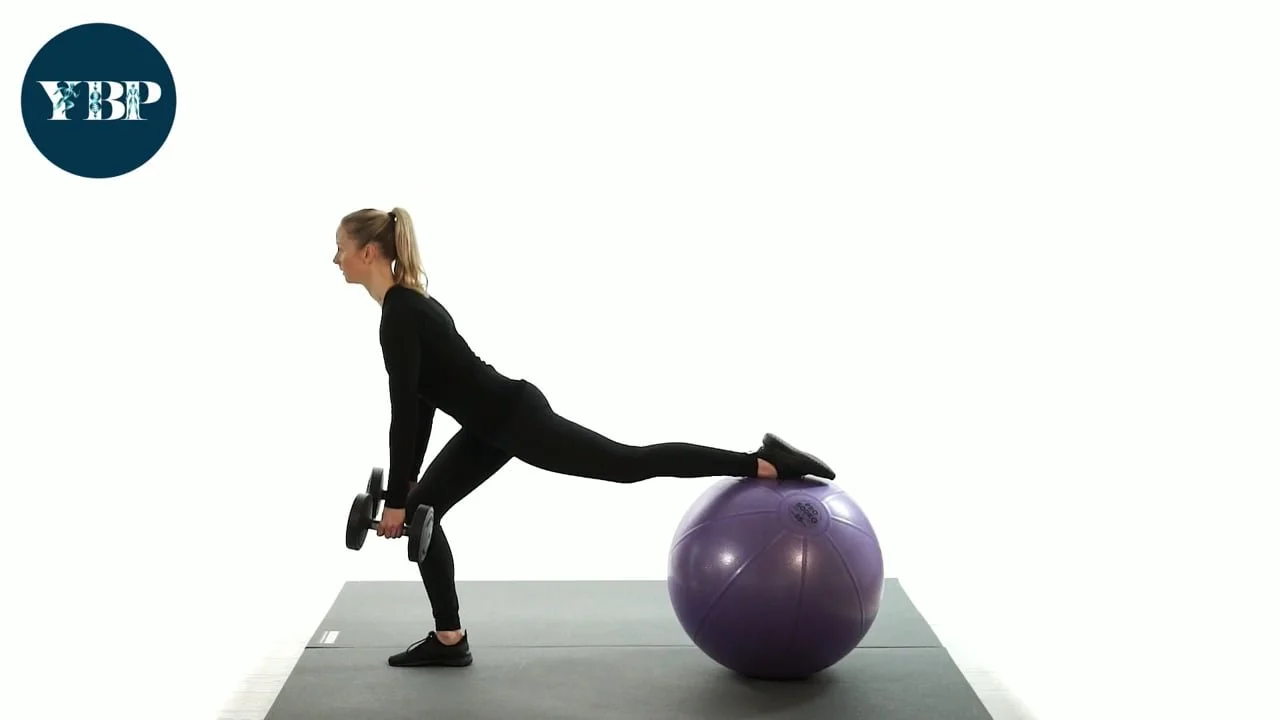
LUNGE — Swiss Ball / Dumbbells
Stand on 1 leg with the opposite foot placed onto a swiss ball behind you with the knee flexed and hold dumbbells to your side. Bend the supporting leg and extend the back leg allowing the ball to roll backwards. Lean the torso forward over the front leg and maintain ankle and knee alignment. Roll the ball inwards as you extend the front leg bringing the body upright.
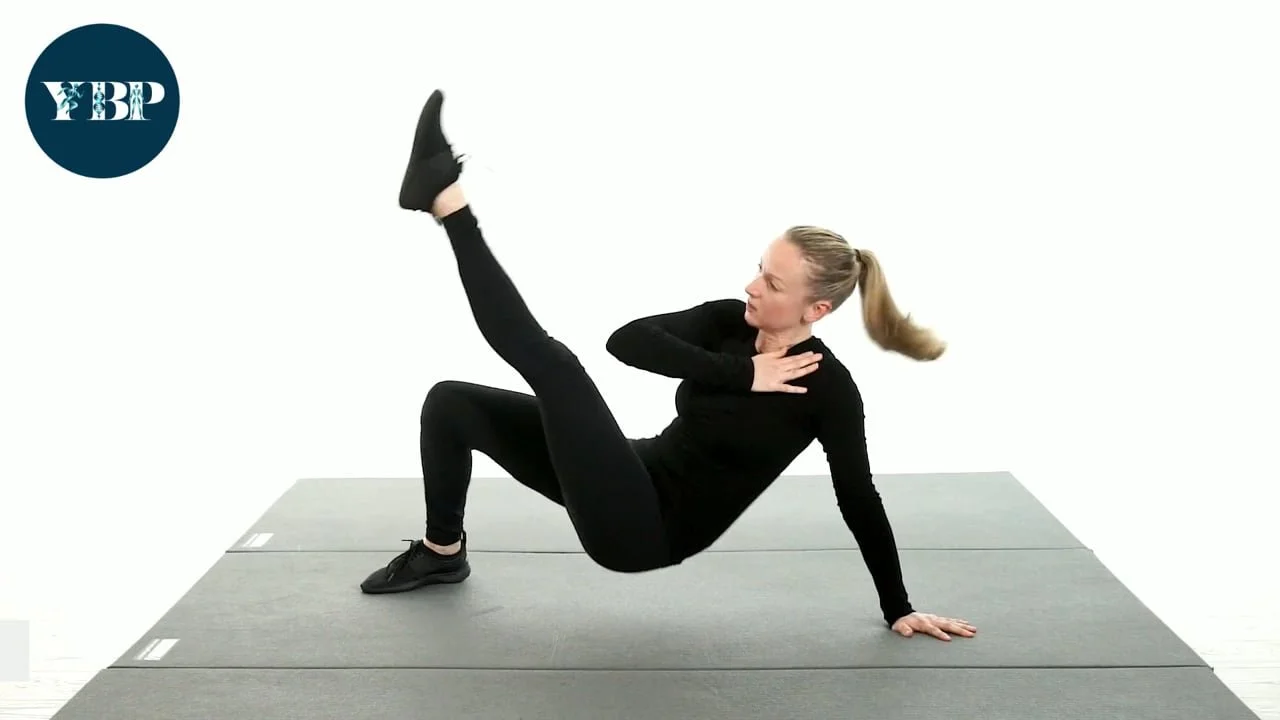
AEROBIC / BREAKDANCE
Begin on all 4s with the knees raised just off the floor. Take your weight onto 1 hand and the opposite foot and simultaneously twist the body and pass the free leg under the body. Straighten the leg then return to centre and repeat side to side. Keep the movement continuous.
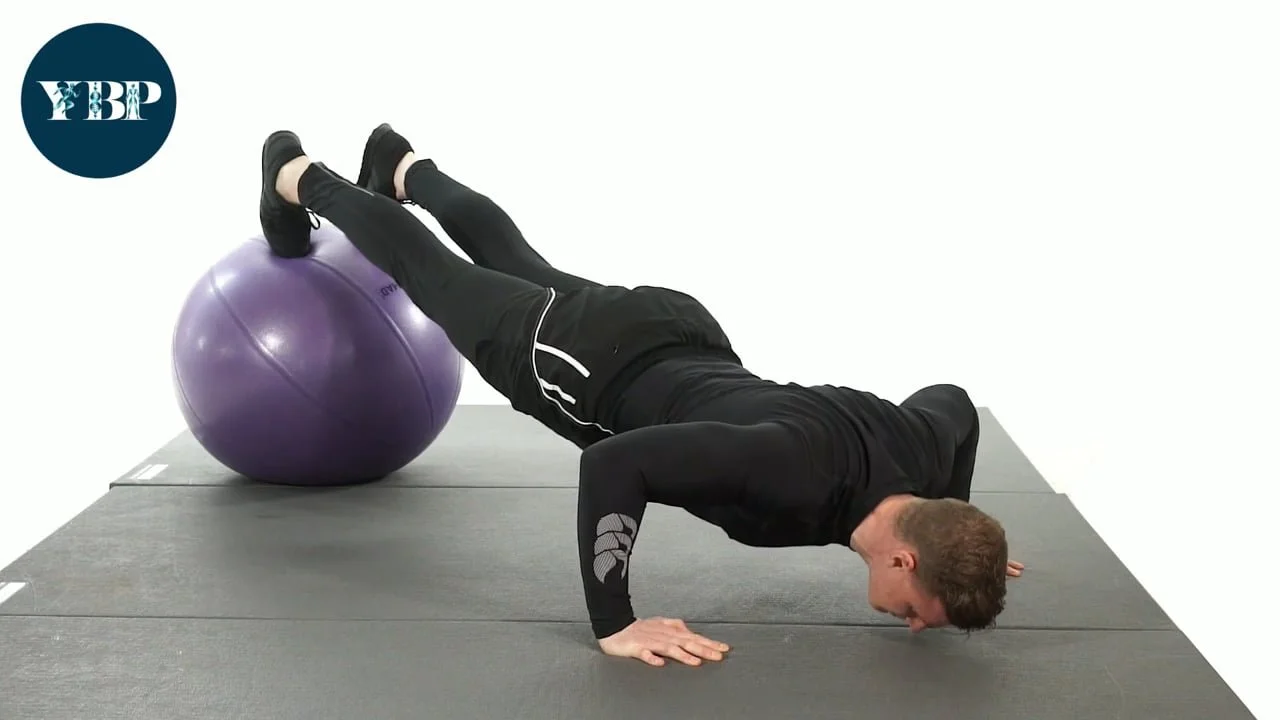
PRESS-UP — Swiss Ball
Begin in a press-up position, feet balanced on a swiss ball, hands just wider than shoulder width and arms extended. Engage your core and keep your body straight. Bend the arms, elbows flared to the side slightly and lower your chest towards the floor. Extend the arms.
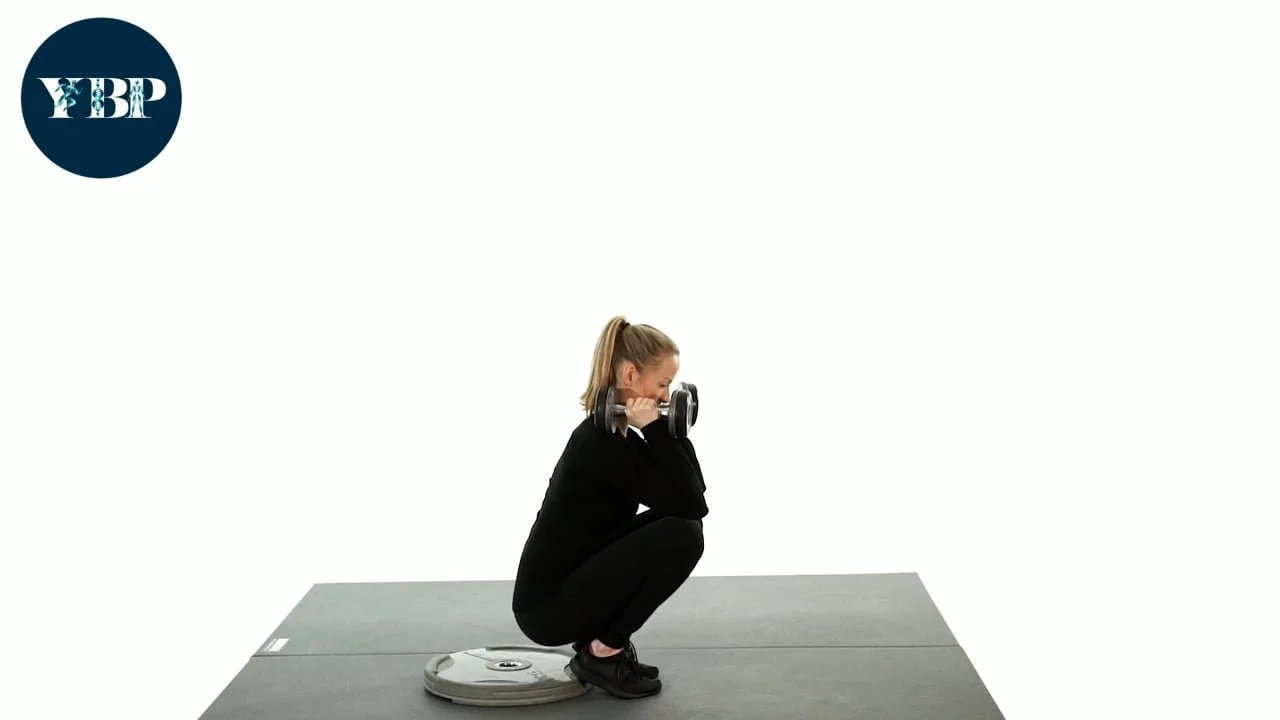
QUAD SQUATS — Dumbbells
Stand with your feet close together and heels raised onto a plate. Hold dumbbells to your shoulders and lower into a squat. Take the squat as deep as possible keeping your chest lifted. Allow the knees to come slightly forward of the toes.
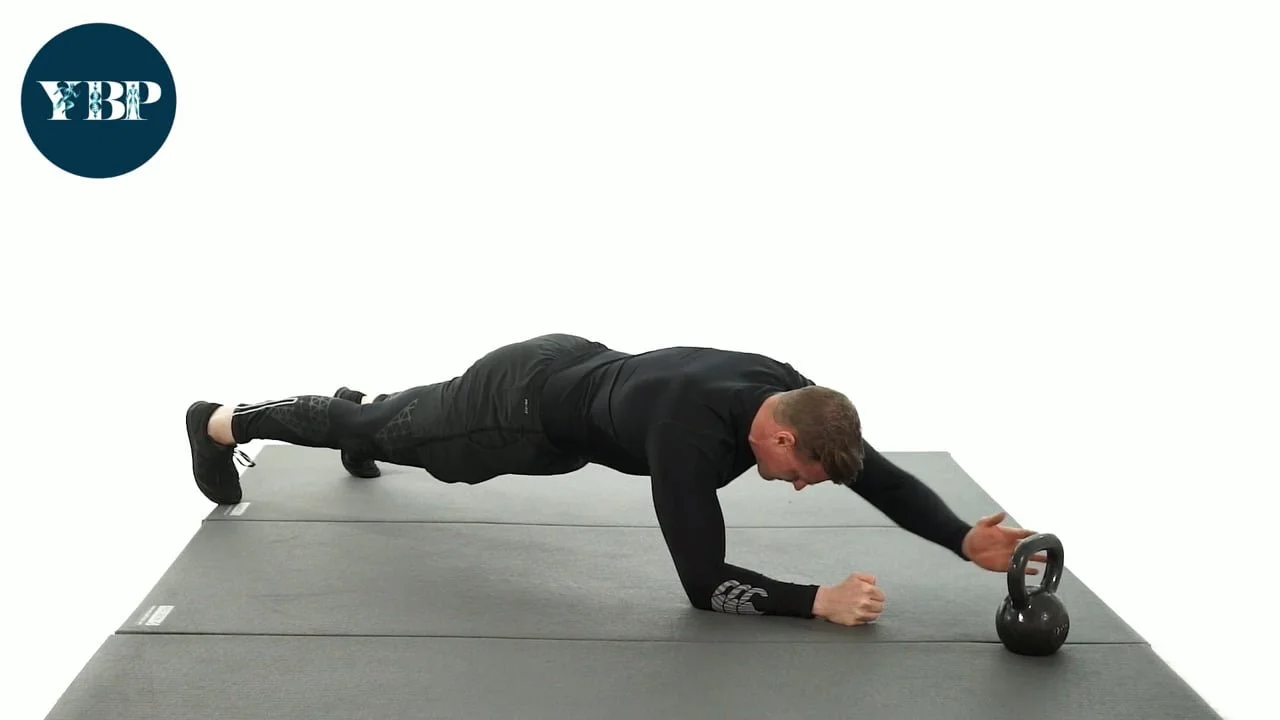
PLANK — Kettlebell
Begin in a plank position with your core engaged. Alternately reach a hand forward to touch a kettlebell (or any object). Maintain your position, do not allow the hips to drop or twist.
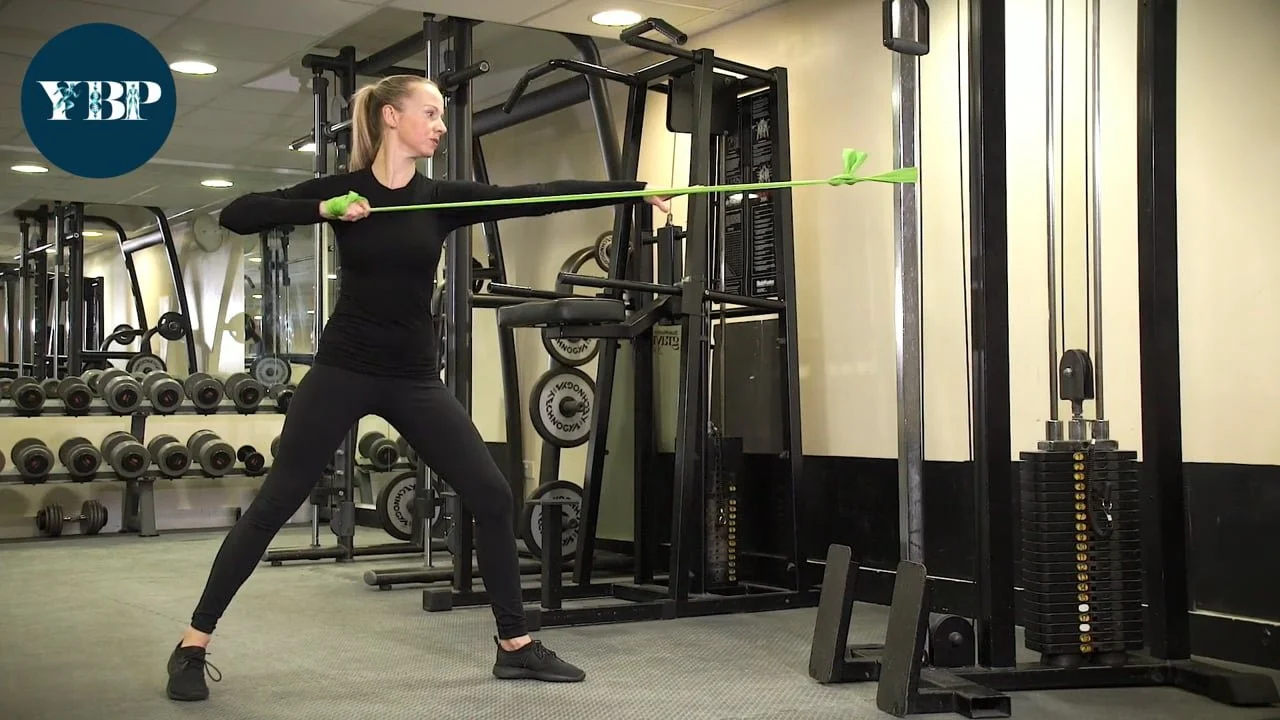
ROW — Band
Stand with the opposite leg forward to working arm. Hold a band in 1 hand with the other end attached at chest height. Pull the band towards you keeping the elbow flared to the side. Rotate the torso as you pull.
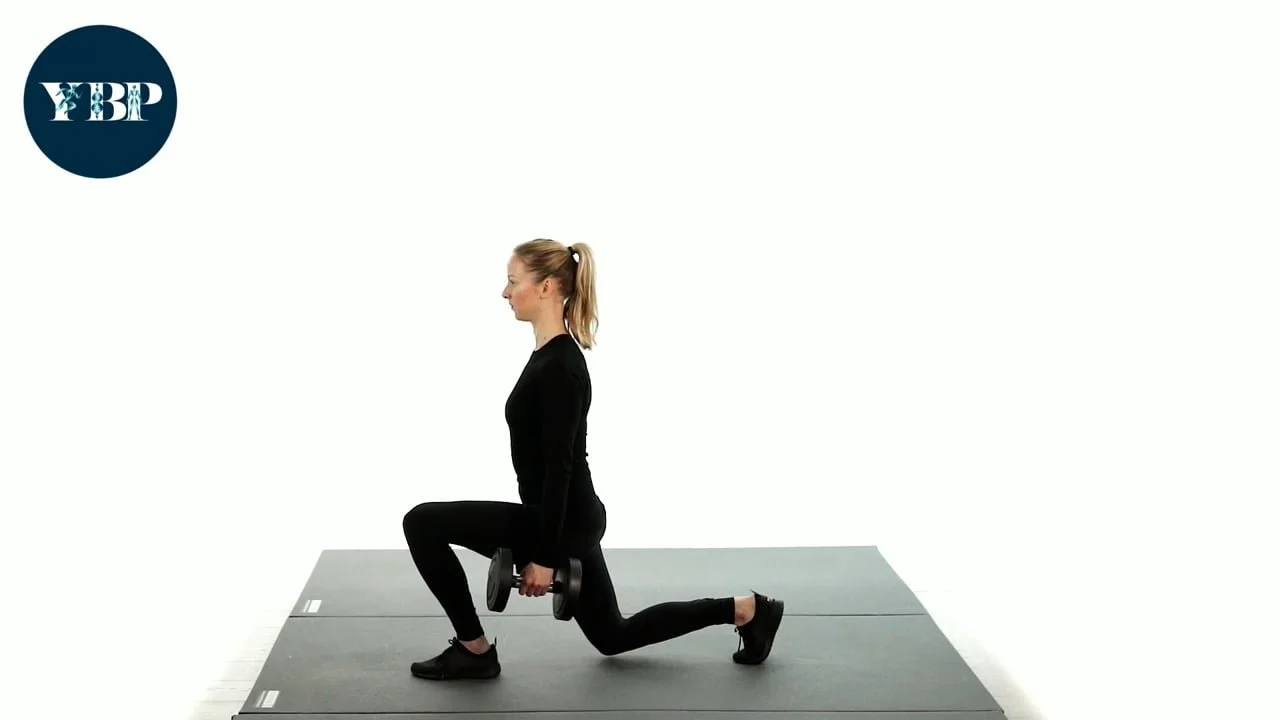
LUNGE — Dumbbells
Stand feet hip width apart and hold dumbbells to your side. Lunge forwards until the back knee is just off the floor and both knees are at right angles. Keep the pelvis slightly tucked under and the body upright. Step together and repeat with the same leg.
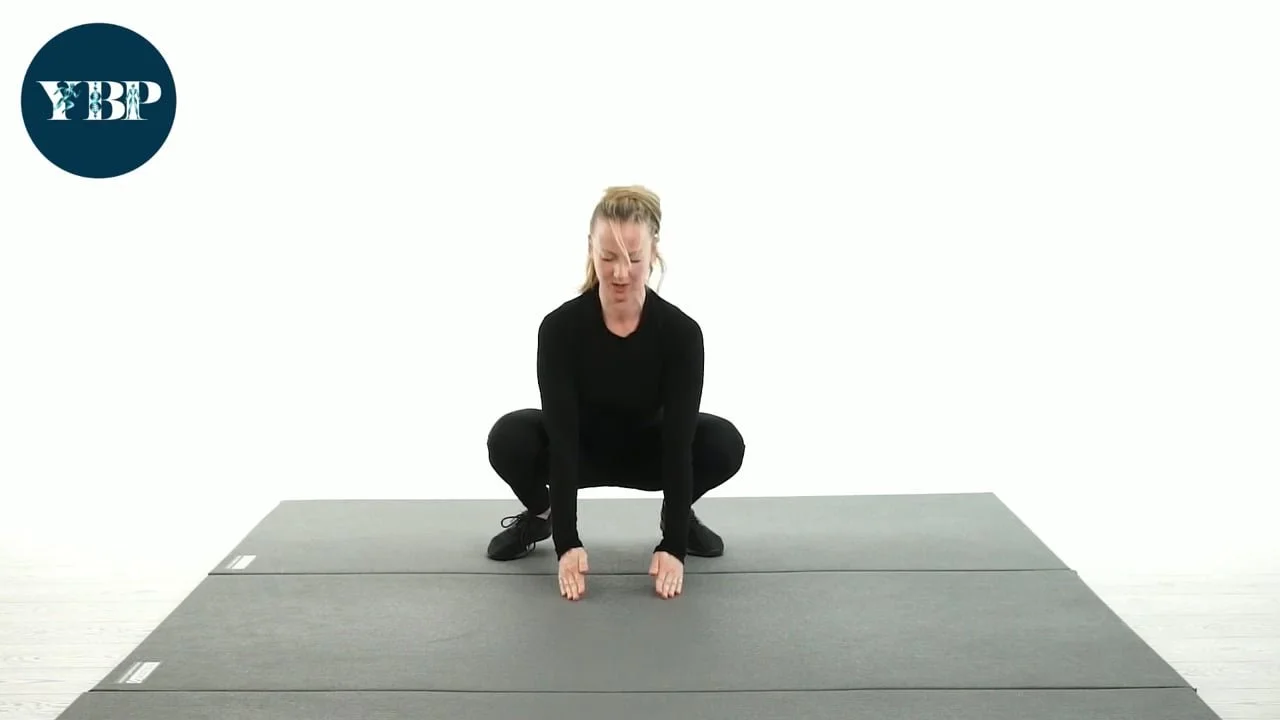
AEROBIC / FROG JUMPS
Squat in a frog position, feet and knees turned out and your hands on the floor between your legs. Reach forward with your arms and take your weight onto your hand. Jump the legs forward and reach your arms up to shoulder height. Reverse the movement jumping backwards.
RESISTANCE WORKOUT TWO
Workout Two Full body
1 circuit of 8 exercises · 15 reps each · 5 sets · every working set to failure · 2 min rest between sets
Block 1 Circuit
5 sets · 8 exercises back to back with minimal rest · 2 min rest between sets
- 1A Chest press — Swiss Ball / Dumbbells · 15 reps
- 1B Leg raises — Swiss Ball / Dumbbell · 15 reps
- 1C Squat — Dumbbells · 15 reps
- 1D Deadlift — Kettlebell · 15 reps
- 1E Lateral flexion — Wall / Swiss Ball / Weight · 15 reps
- 1F Burpee · 15 reps
- 1G Press-up — Medicine Ball · 15 reps
- 1H Aerobic: tuck jumps · 15 reps
How the block types work
- Circuit
- Several exercises done back to back with minimal rest between them. One round of all the exercises is one set; then rest.
Same concept as Workout One. The videos for each exercise are below.
Block 1: Circuit · 8 exercises, 15 reps each · 5 sets, 2 min rest
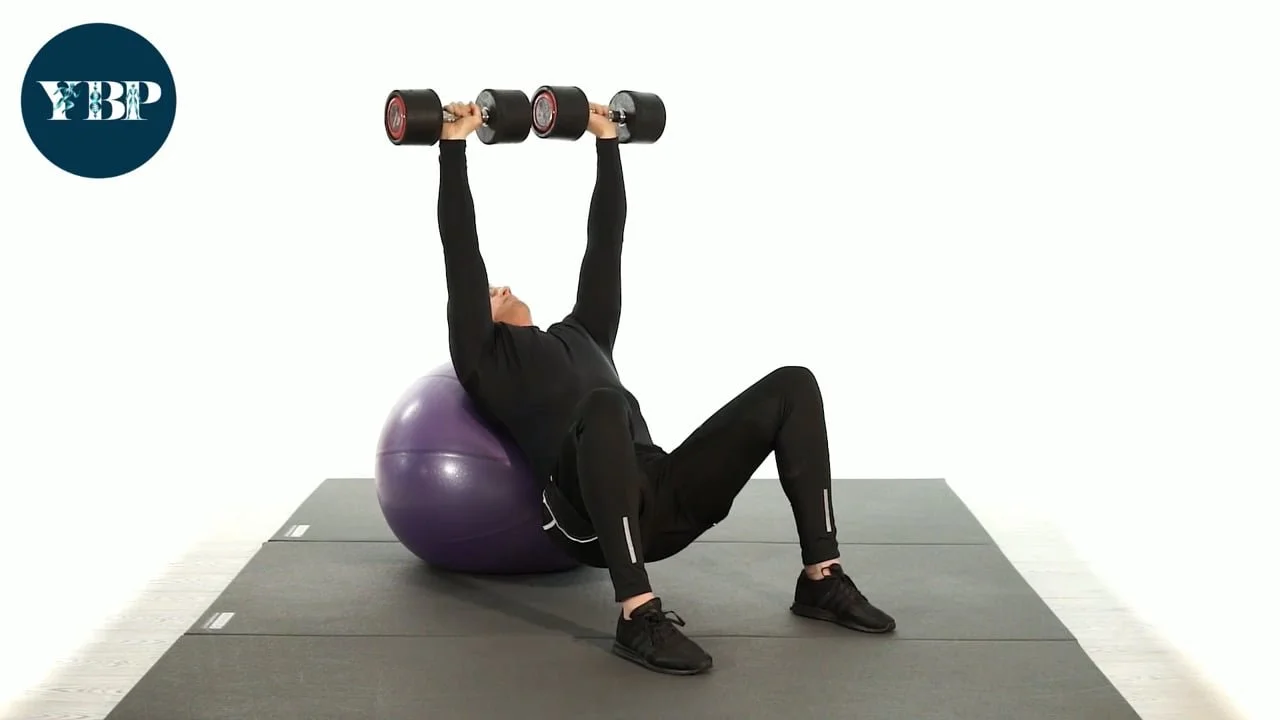
CHEST PRESS — Swiss Ball / Dumbbells
Support your upper back on a swiss ball and lower your hips towards the floor. Hold dumbbells above you with your arms fully extended. Inhale as you bend your arms bringing the hands towards the shoulders with your elbows flared to the side and exhale as you extend.
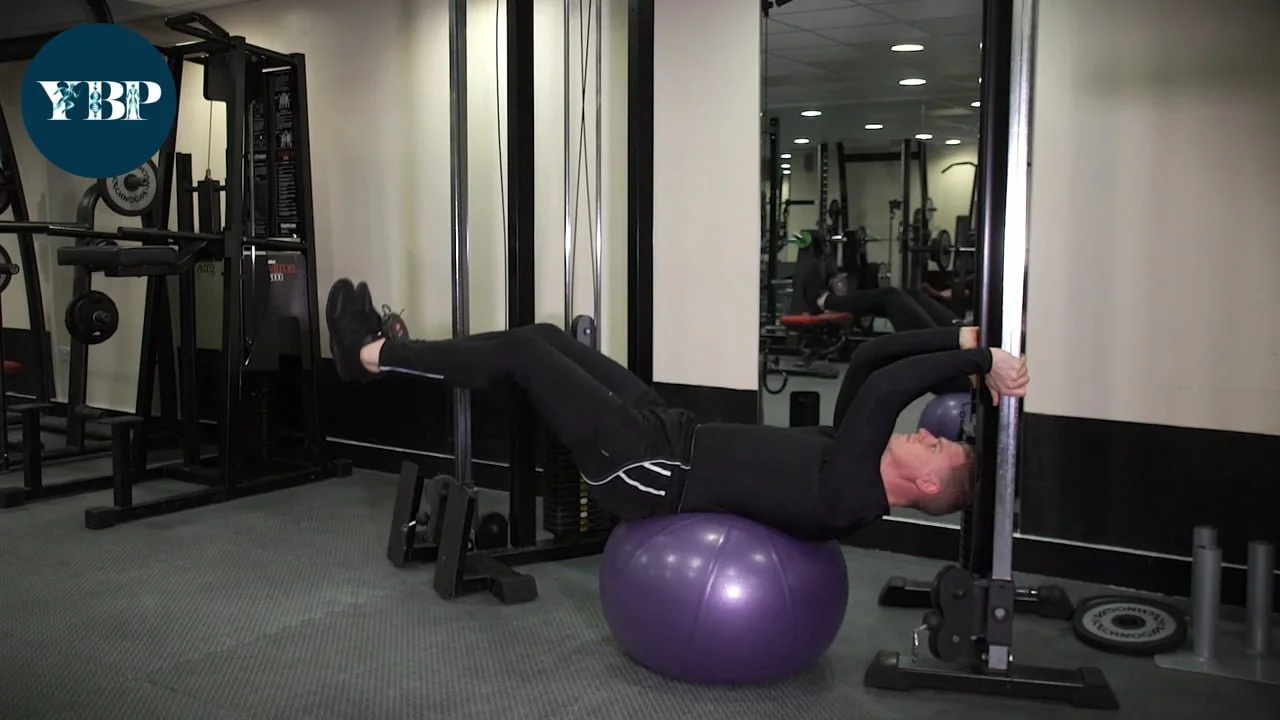
LEG RAISES — Swiss Ball / Dumbbell
Lie with your back over a swiss ball, legs raised above you with slight knee flexion and a dumbbell held between the feet. Hold onto a stable surface behind you. Engage your core, inhale and lower the legs towards the floor whilst maintaining neutral spine. Exhale and raise the legs.
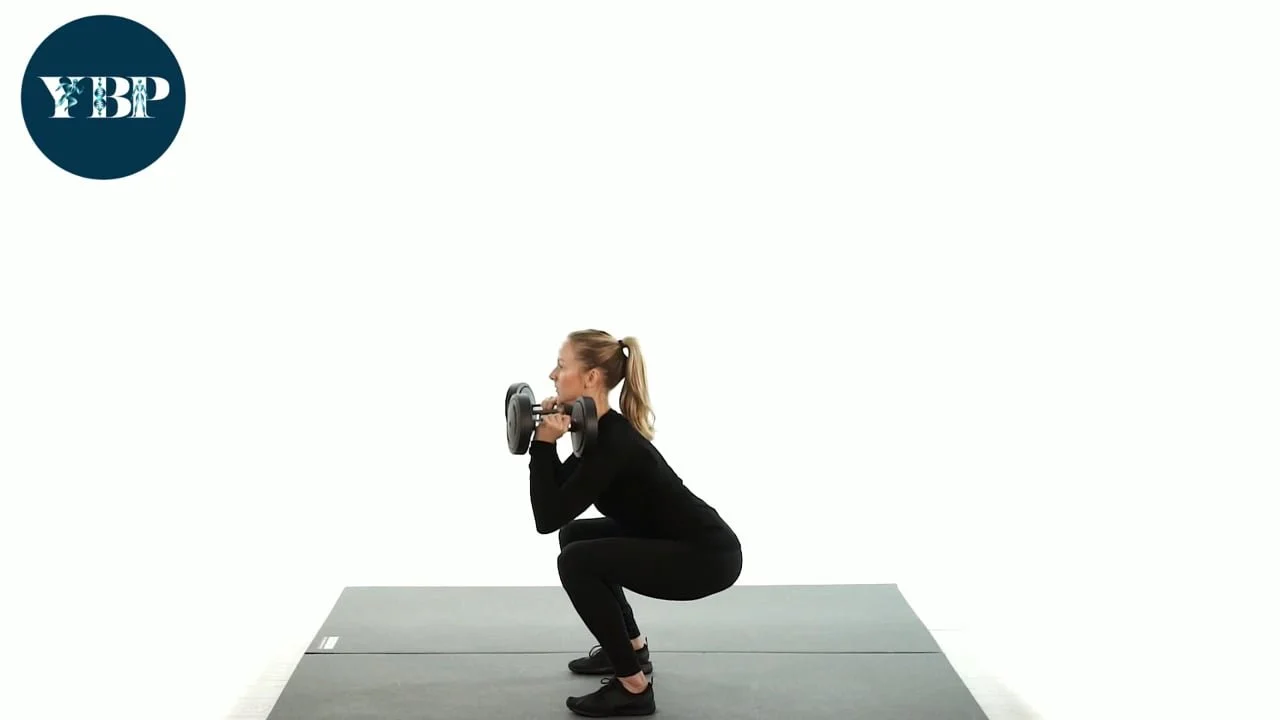
SQUAT — Dumbbells
Stand feet shoulder width apart and hold dumbbells to your shoulders. Bend the knees into a deep squat, push the bottom backwards and maintain neutral spine. As you straighten the legs, press the dumbbells overhead. Make sure your knees track inline with your toes.
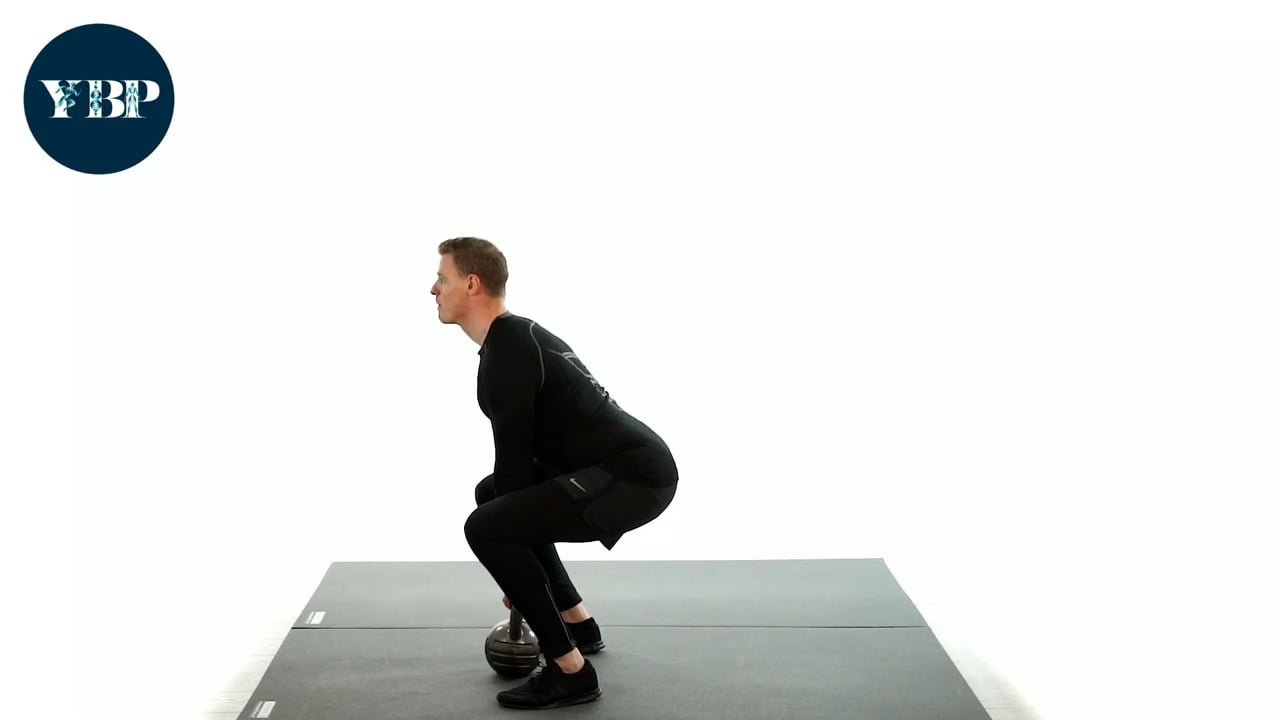
DEADLIFT — Kettlebell
Stand feet shoulder width apart, bend the knees, hinge from the hips and take hold of the kettlebell in both hands. Perform a deadlift by pressing the feet into the ground and straightening the legs. Do not let the lower back round, maintain neutral spine. Lower under control.
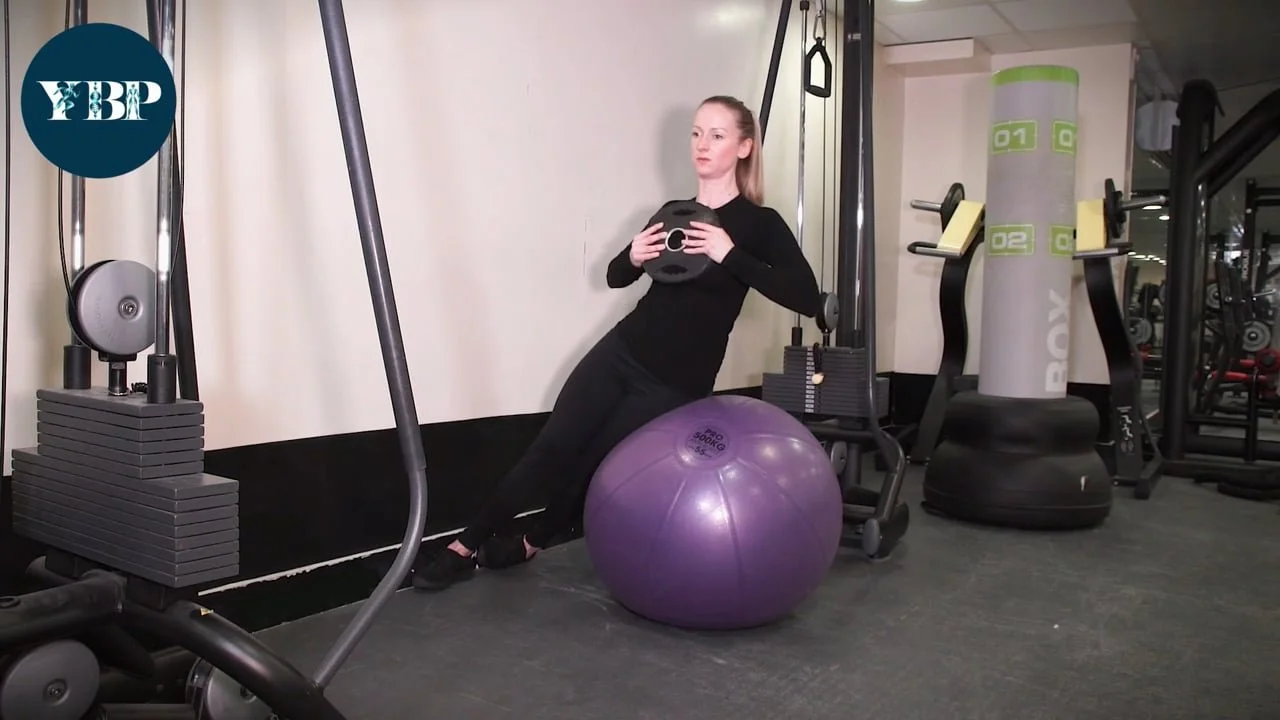
LATERAL FLEXION — Wall / Swiss Ball / Weight
Lie laterally with your hip supported on top of a swiss ball and your feet wedged against a wall to maintain balance. Hold a weight to your chest, engage your core then lower and raise your body over the ball.

BURPEE
Stand with your feet hip width apart and jump as high as possible. As you land, place your hands on the floor and jump your legs back into a plank position with your body extended. Perform a press-up. Jump your feet back towards your hands and begin again. Keep the movement as fluid as possible.

PRESS-UP — Medicine Ball
Begin in a press-up position, feet balanced on a medicine ball, hands just wider than shoulder width and arms extended. Engage your core and keep your body straight. Bend the arms, elbows flared to the side slightly and lower your chest towards the floor. Extend the arms.

AEROBIC / TUCK JUMPS
Begin standing with your feet hip width apart, bend the knees and jump as high as possible bringing your knees up to your chest. Land then prepare again.
CARDIO WORKOUT
SPRINT PHASE
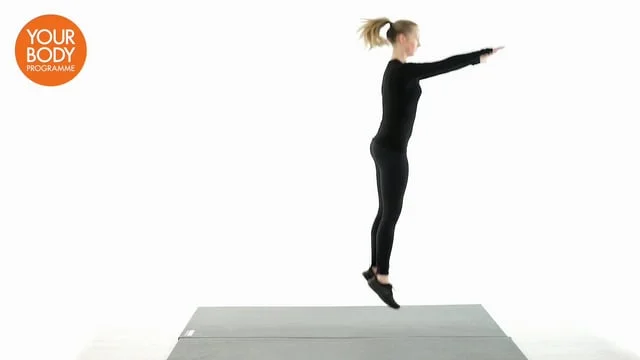
This video shows examples of cardio exercises to use when performing the sprint phase of your interval training. Choose one that suits your level.
REST PHASE
This is the recovery phase. Choose from marching on the spot, an easy jog or a combination of the two.
Your cardio
You have 3 or 4 cardio sessions a week, on their own days, not on your weights days.
Each session has three parts. First, 12 intervals: sprint for 30 s at 100%, the highest intensity possible, then recover for 20 s at a low intensity. Then 18 minutes of continuous movement, as hard as you can keep up for the whole time: this helps clear the lactic acid built up by the hard intervals. Then the same 12 intervals again. About 38 minutes in total.
Use any cardio equipment: cross trainer, treadmill, rower, bike or skipping rope. You can combine equipment rather than doing the whole session on one machine. Training at home? Use the sprint phase video below to choose your exercises.
| Your cardio session | |
|---|---|
| Sessions per week | 3 or 4 |
| Whole session | 38 mins |
| Intervals | 12 × 30 s |
| Interval effort | 100%: the highest intensity possible |
| Recovery after each interval | 20 s, low intensity: march on the spot or jog easily |
| Lactic acid removal | 18 mins, as hard as you can keep up for the whole time |
| Then | Same intervals again |
| Equipment | Cross trainer, treadmill, rower, bike or skipping rope |
STRETCHES
Hold each position for 1 minute and increase the length of time on particularly tight muscles.
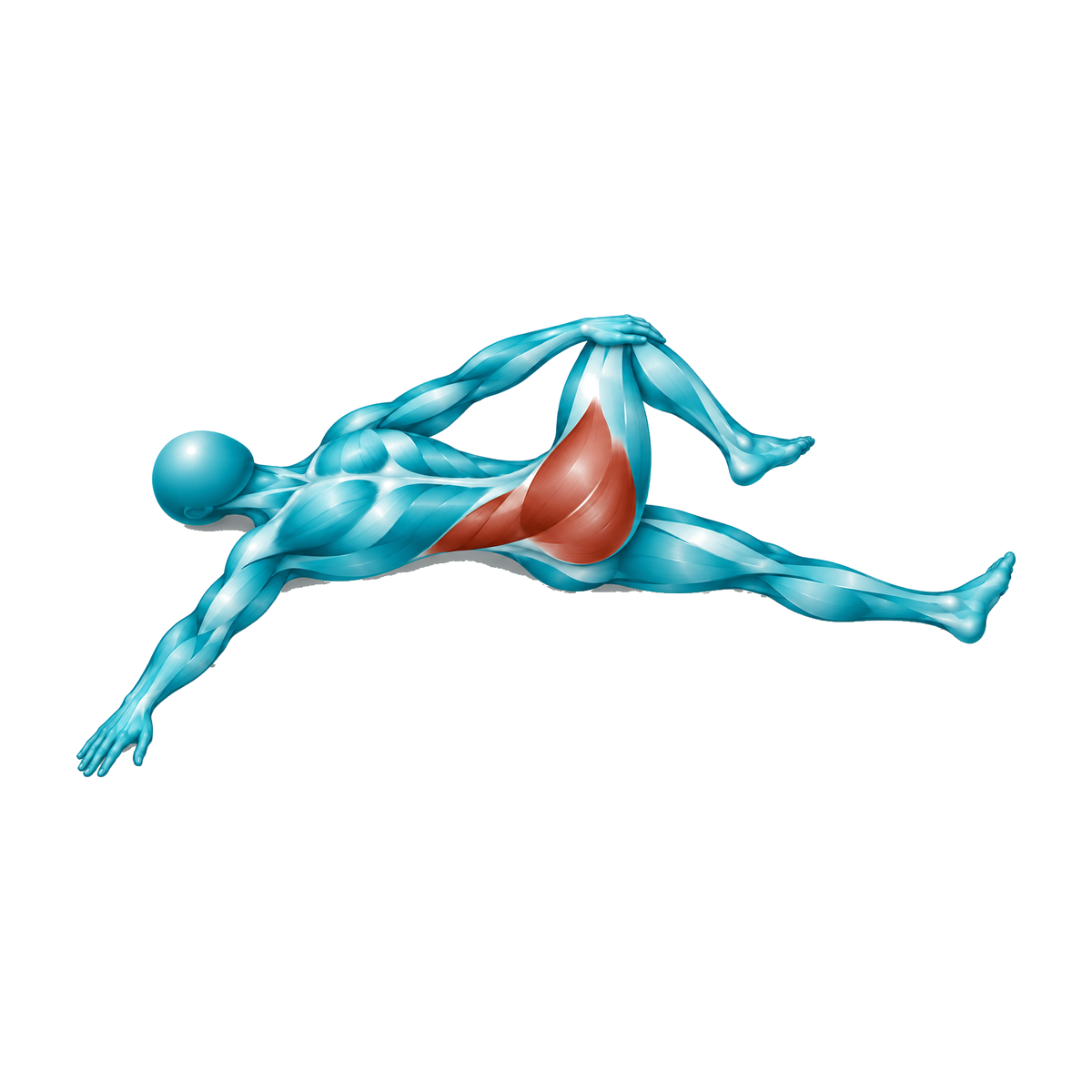
GLUTES & BACK
Lie on your back with your arms stretched out wide, take one knee across your body and apply gentle pressure drawing the knee towards the floor.
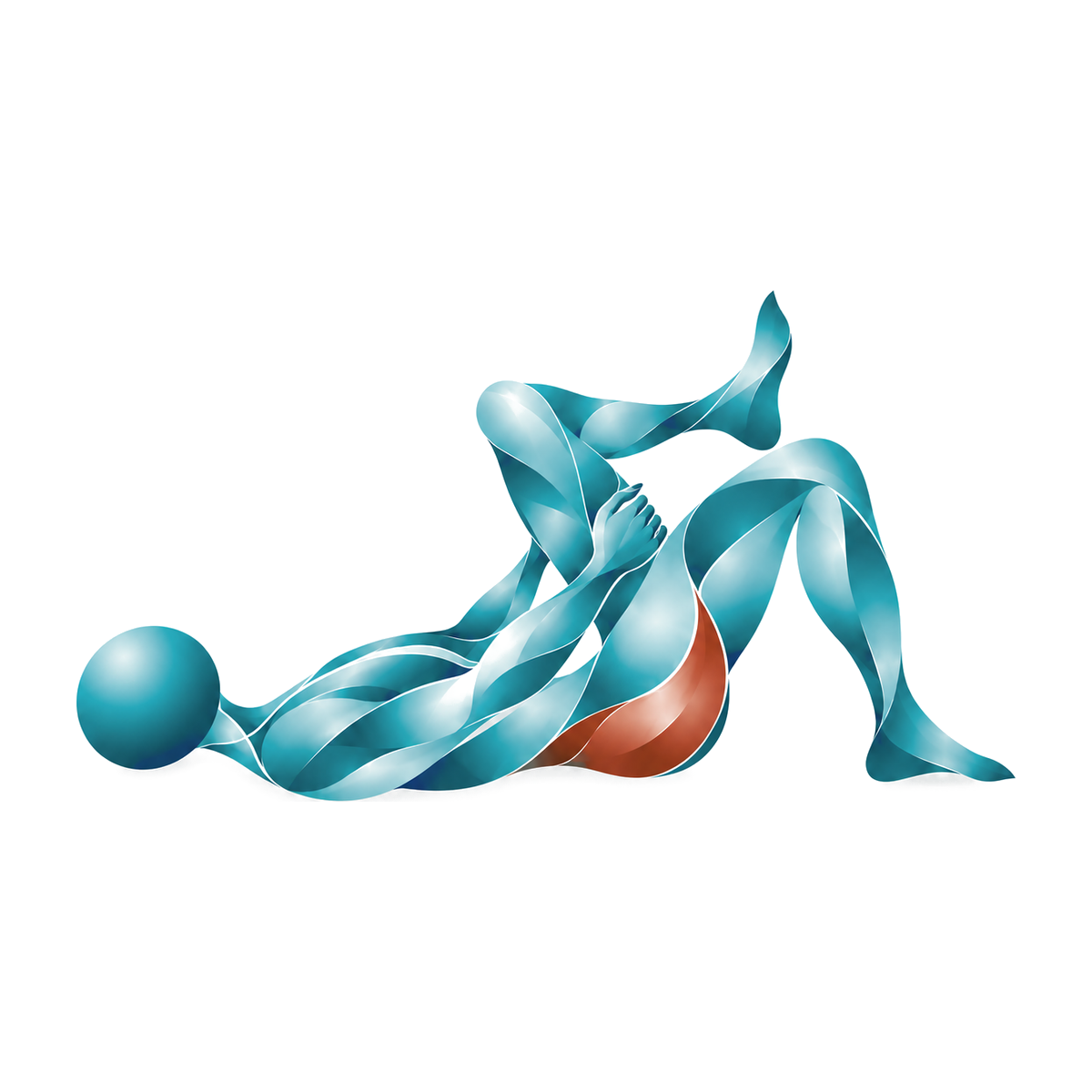
GLUTES
Lie on your back and place your foot onto the opposite knee. Press the top knee outwards as you clasp the underneath leg and draw it towards you.
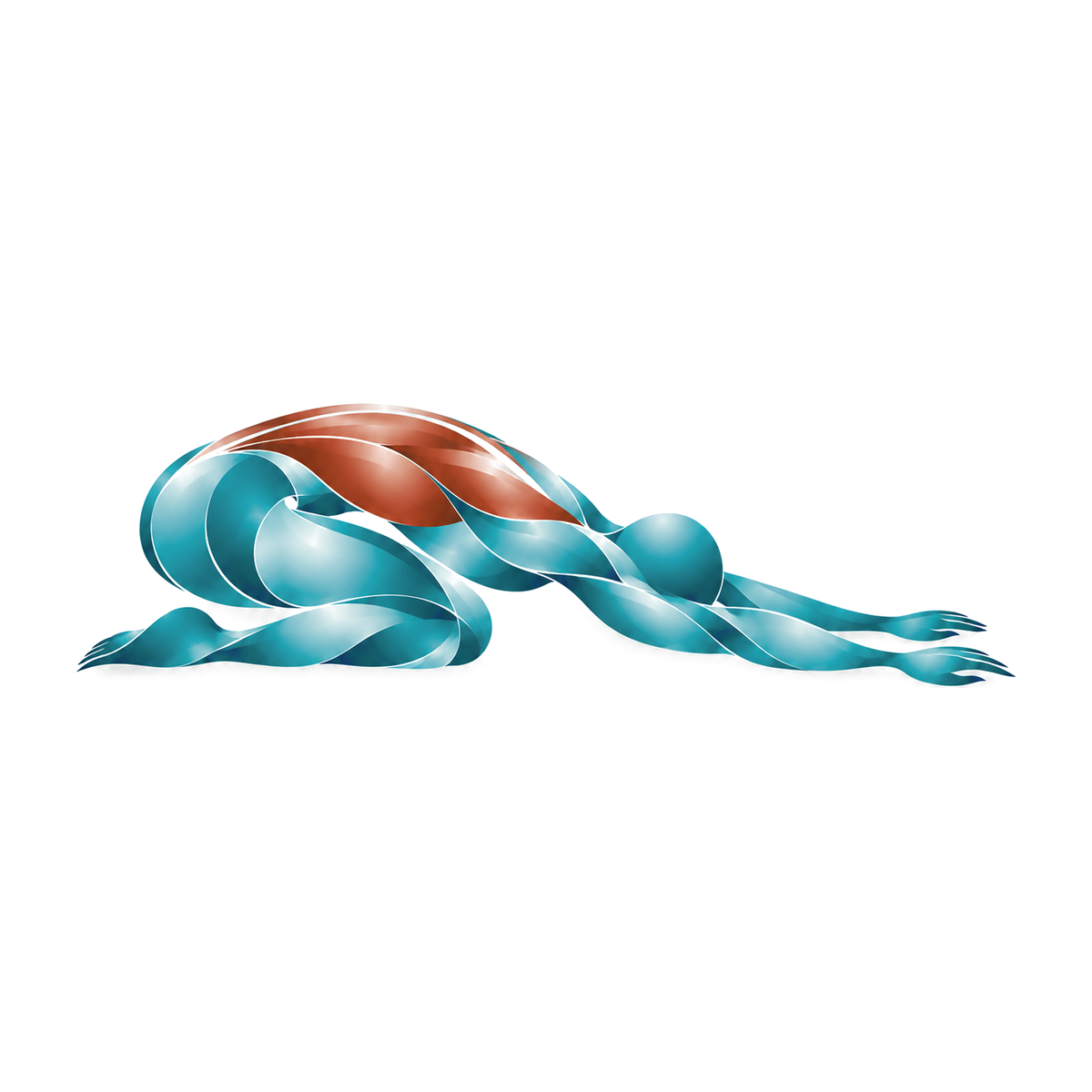
BACK
Sit back onto your heels and simultaneously reach your hands forward with your forehead resting on the floor.
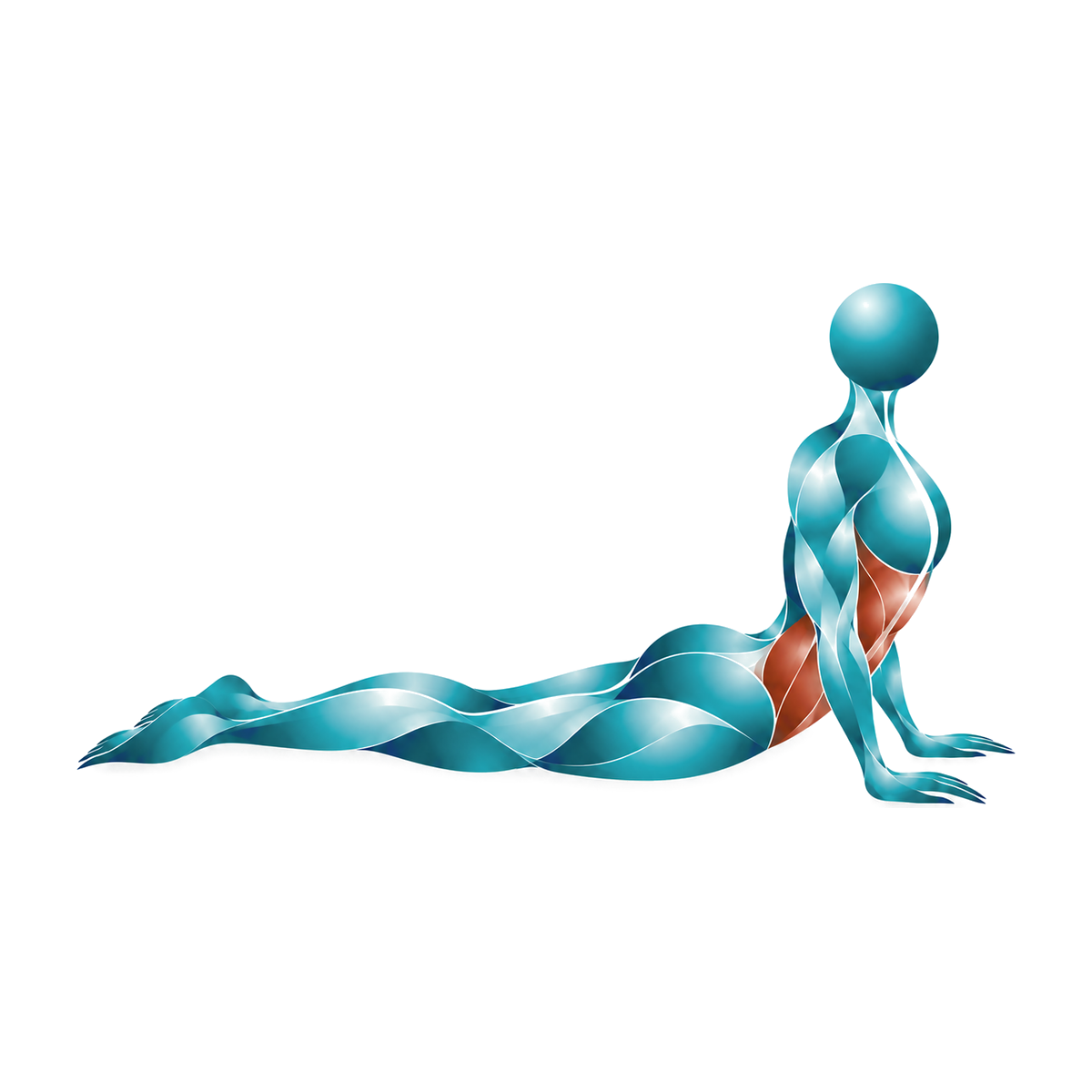
ABDOMINALS
Lie prone (on your front) and place your hands beneath your shoulders. Press into the floor, straighten your arms and raise your body.
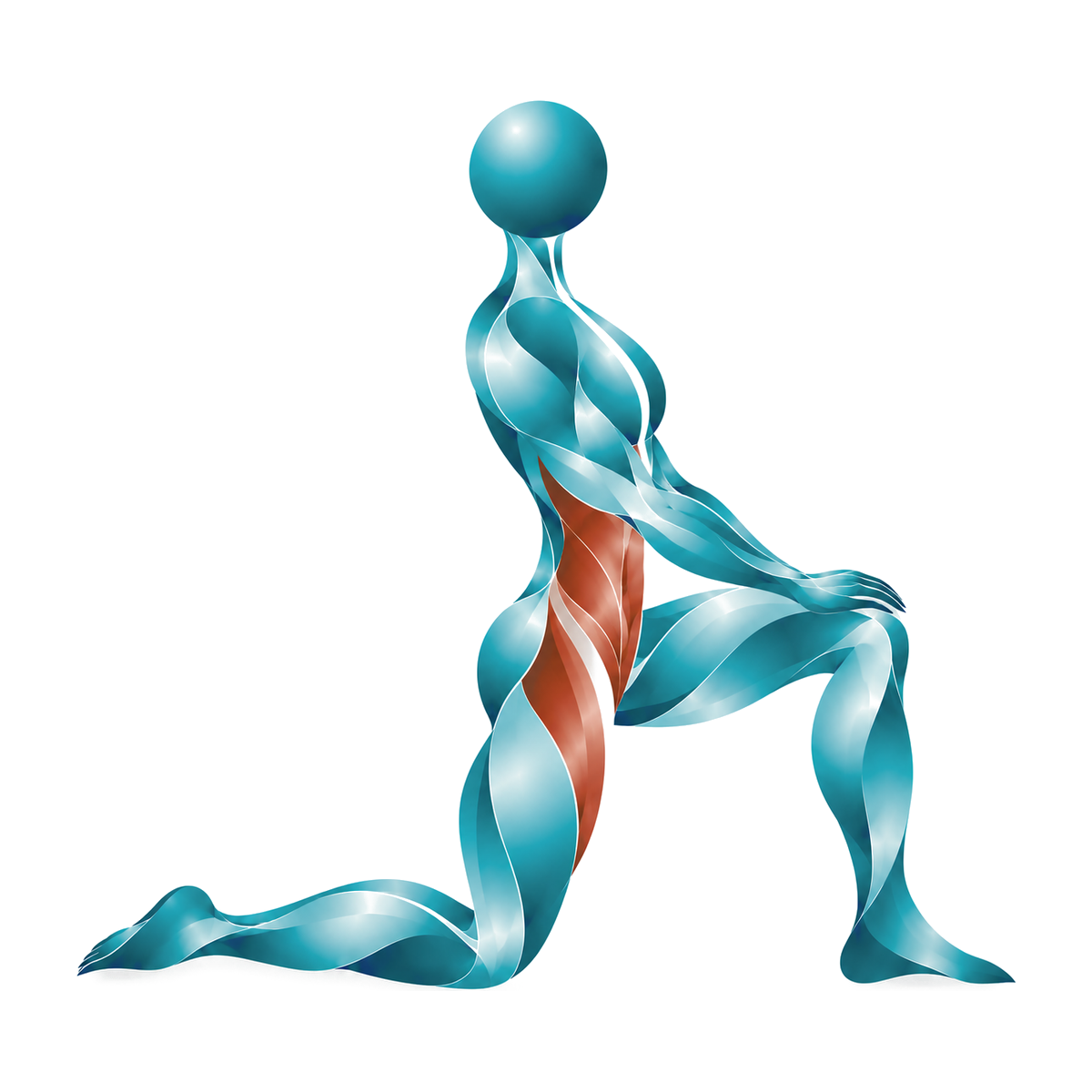
HIP FLEXOR
In a half kneeling position tuck your pelvis under, squeeze your glutes and press your hips forward.
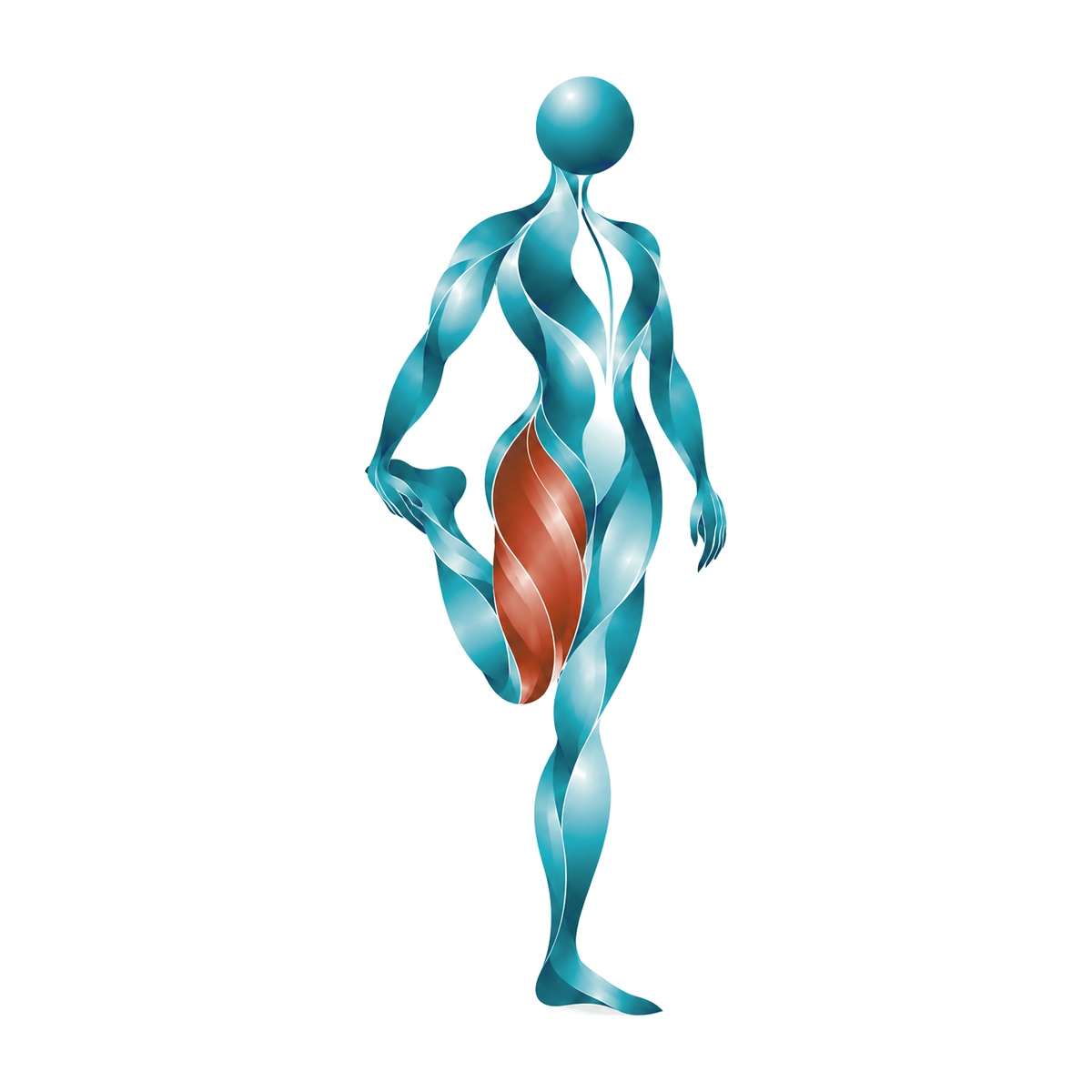
QUADS
Draw your foot towards your bottom. Squeeze your glutes, tuck your pelvis under and keep your knees together.
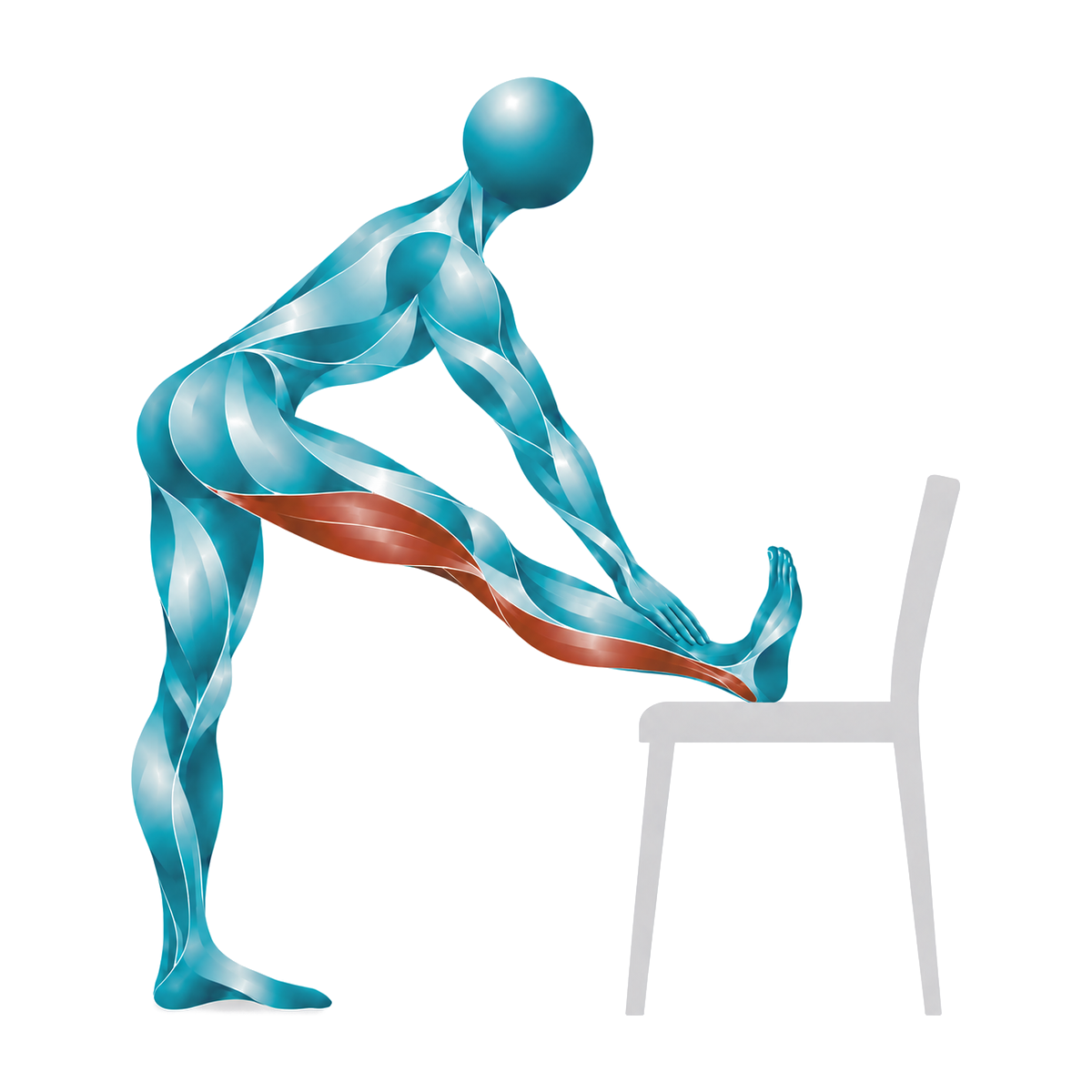
HAMSTRINGS & CALF
Raise your foot onto a surface and lean your body forward. Flex the foot bringing the toe towards you.
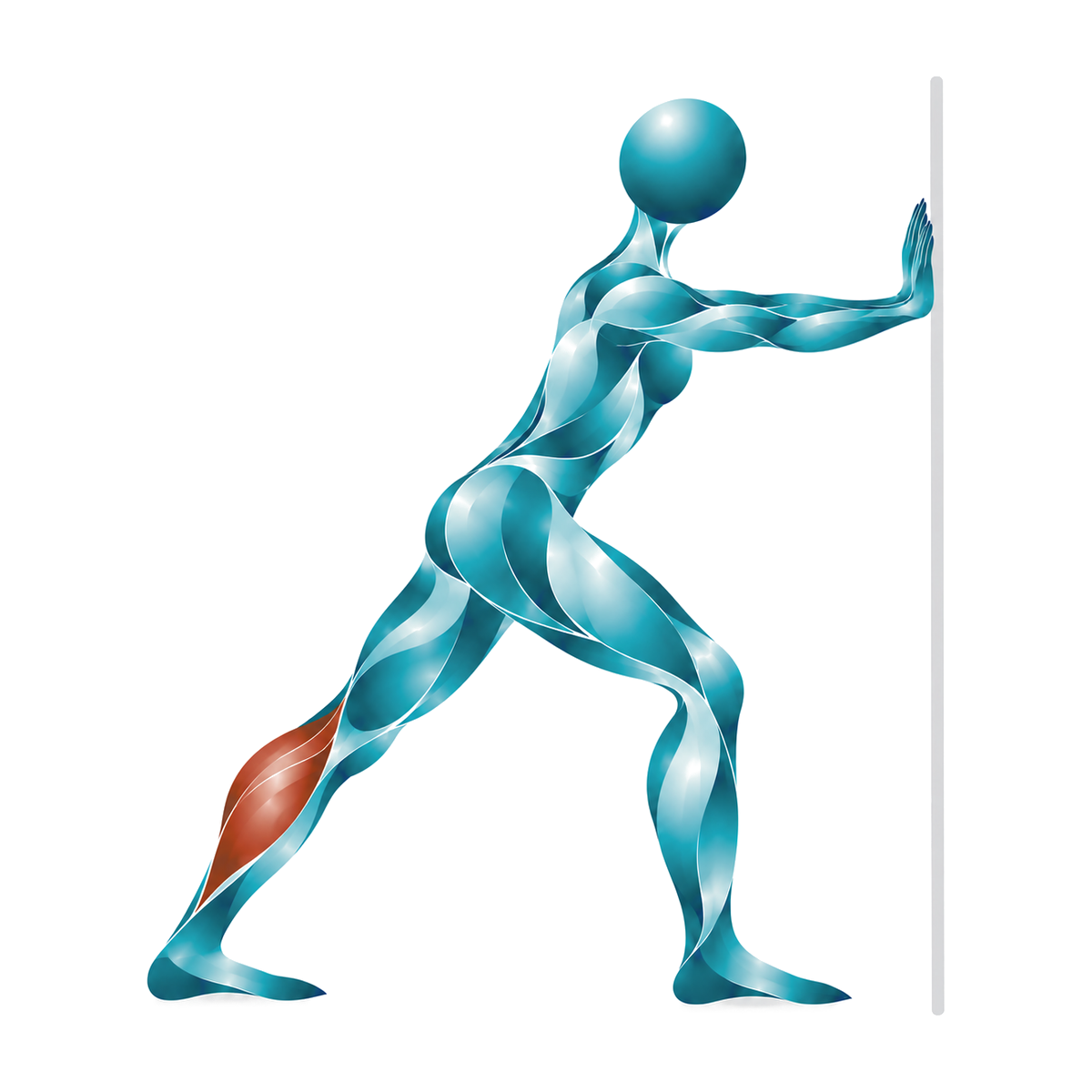
CALF
Lean into a wall, extend the back knee and press the heel into the floor. Ensure both feet are in a parallel position.
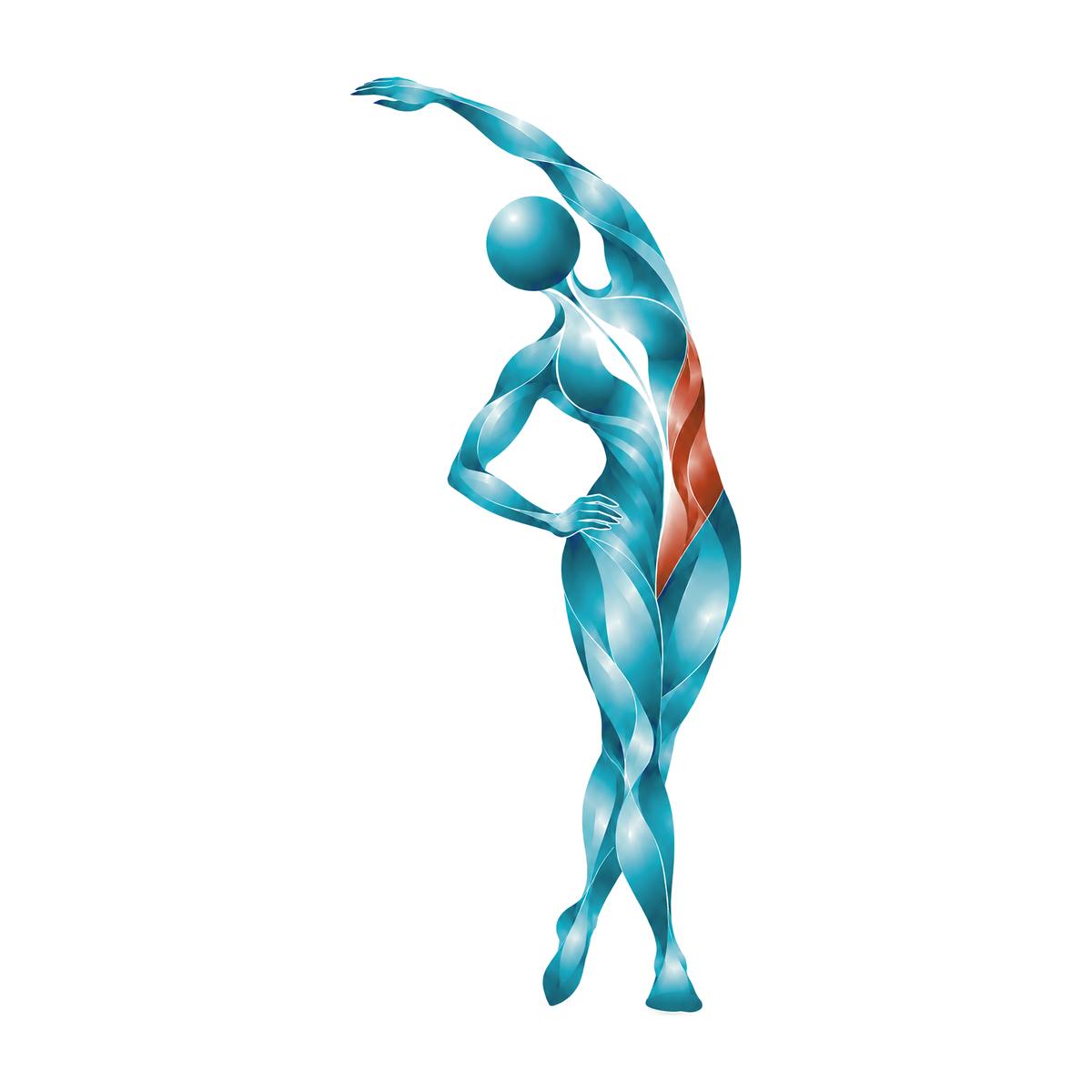
LATERAL
Place one foot behind the other and reach the same arm (as back leg) overhead. To increase the stretch lean laterally.
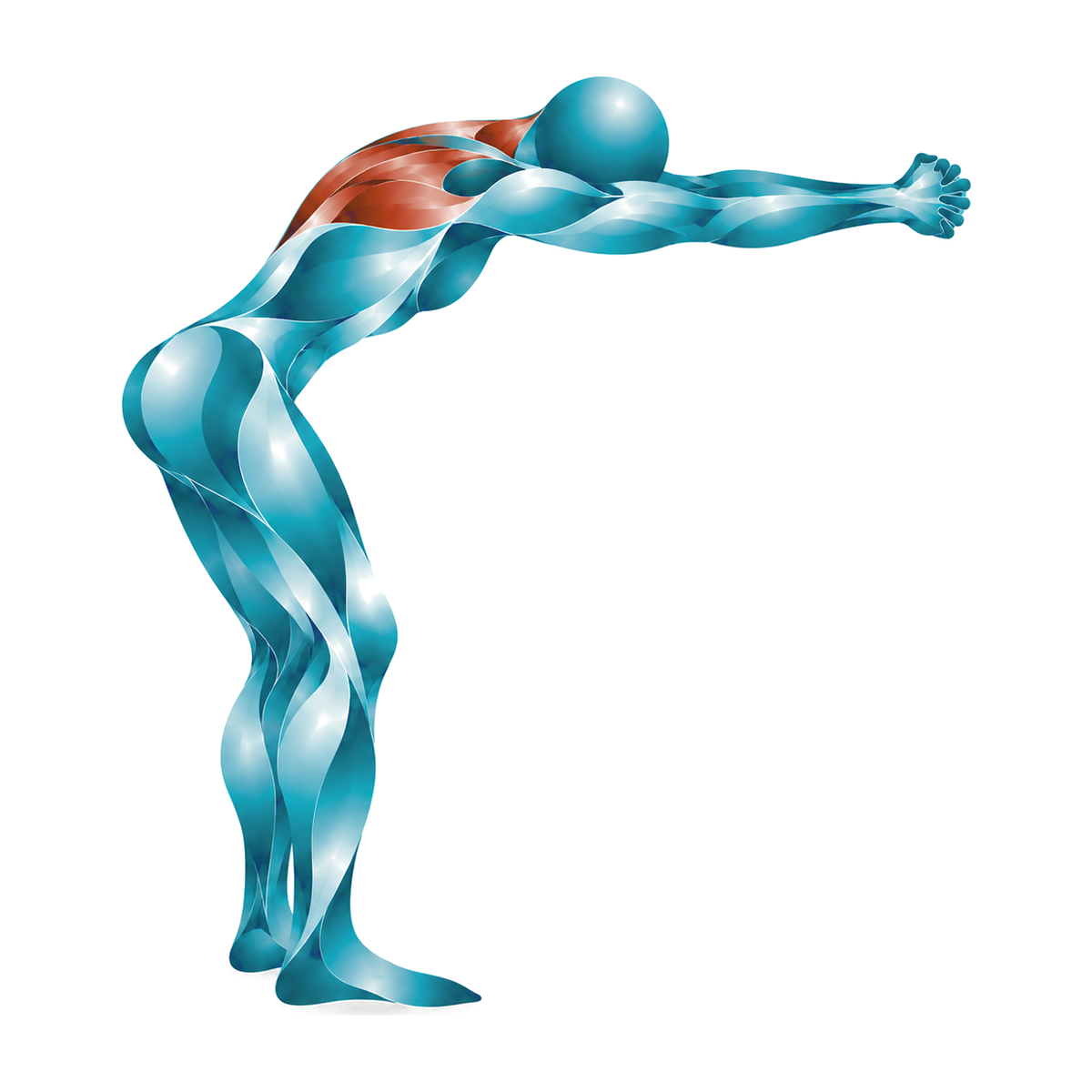
UPPER BACK
Place your hands together and reach forward. Drop your head between your arms and curve your upper back.
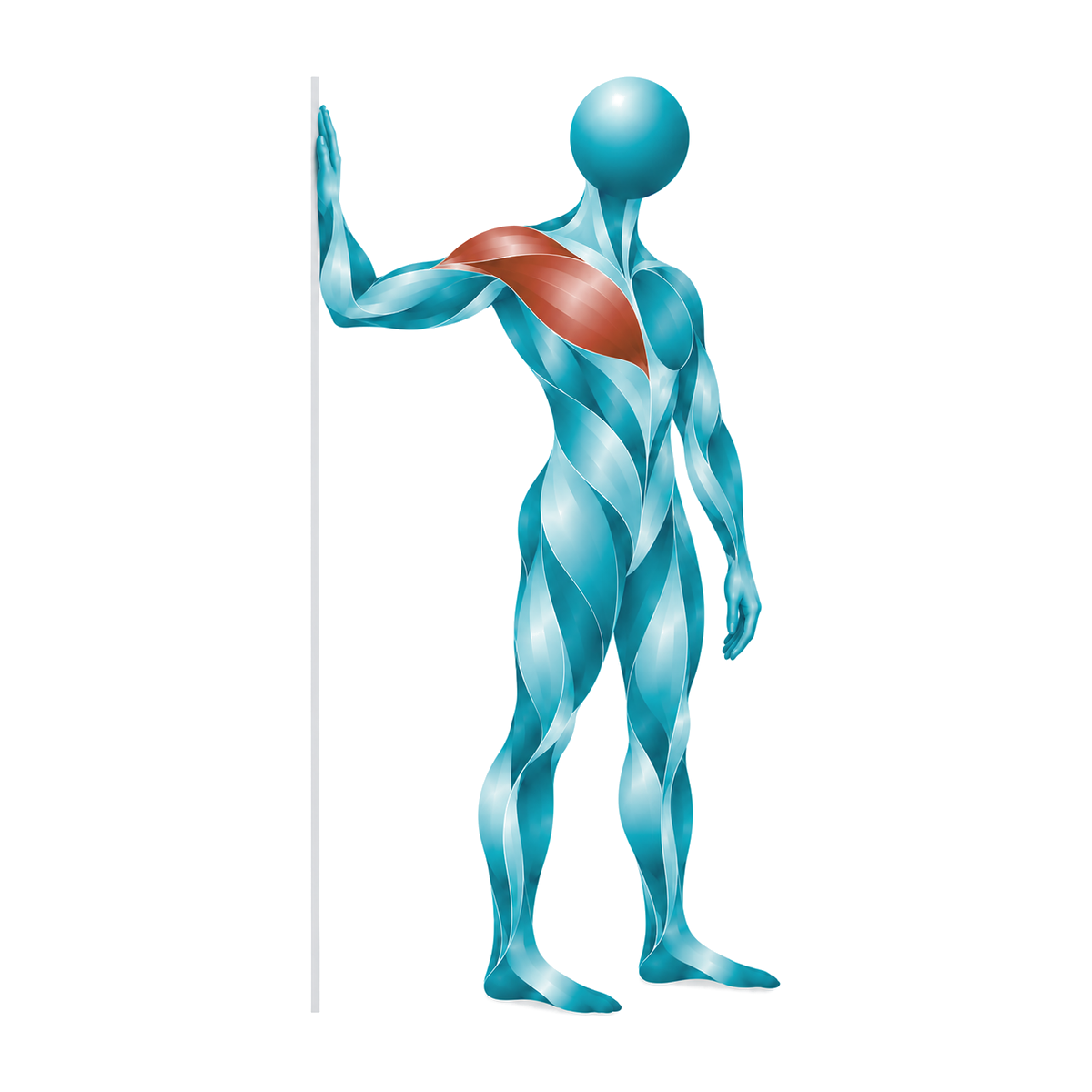
CHEST
Place your hand flat on a wall with your arm raised just above shoulder height and the elbow slightly bent. Turn your chest and body away from the wall until you feel a stretch across the front of your chest and shoulder.
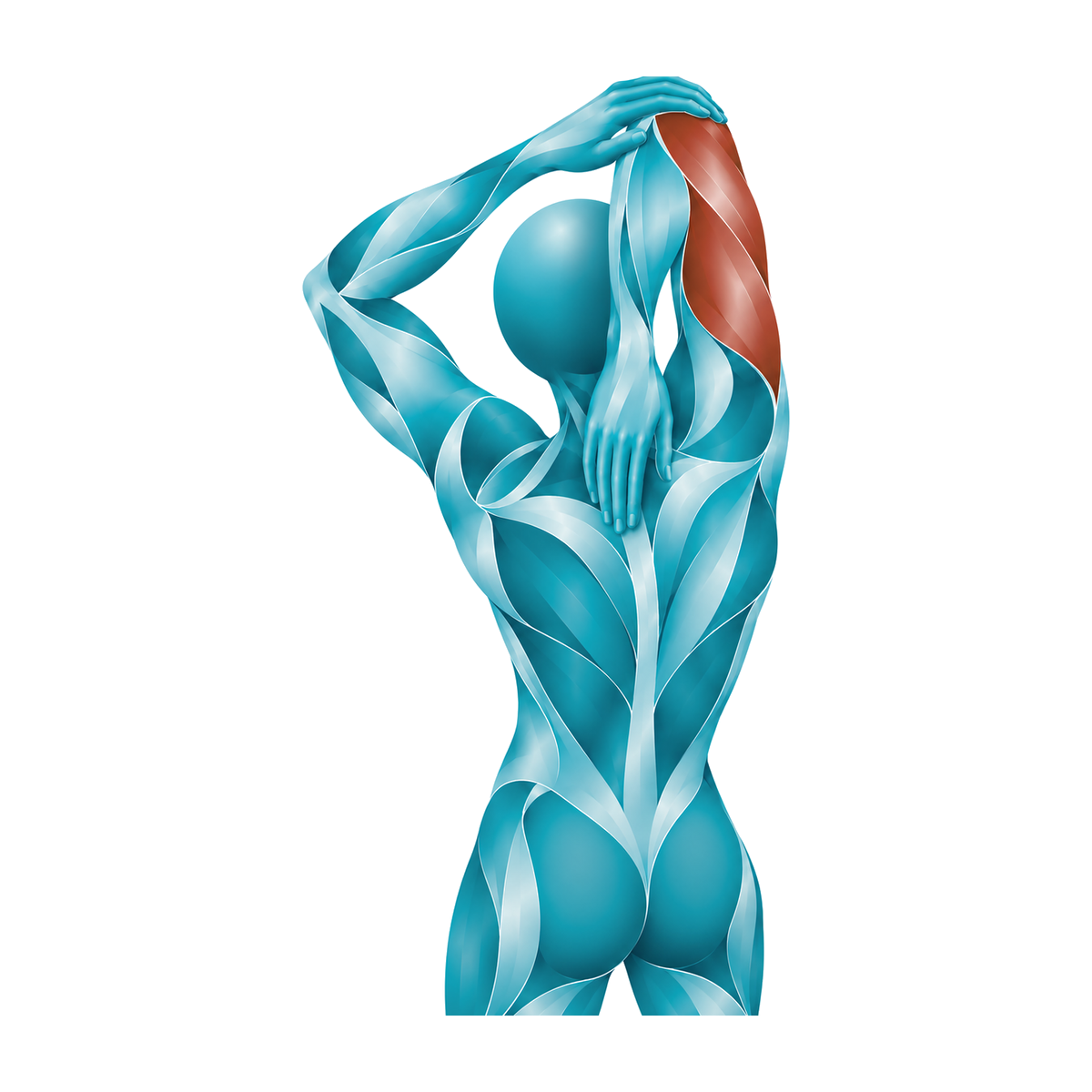
TRICEPS
Take one arm overhead and bend at the elbow. Apply pressure with the opposite hand and keep the head raised.
ALTERNATIVE EXERCISES
Use this section to replace specific exercises in your programme which do not work for you. This may be due to not having the correct equipment, the exercise being too challenging / not challenging enough, or possibly due to an injury. Click on the links below to find alternative exercises for the same body part or movement.
EXERCISE SCIENCE FOR THE CURIOUS
+ Read more× Close
For the curious: the science behind your training, in more detail, for those who want to know exactly what is happening inside the body. Tap any topic to read more.
How fat loss works
Step by step, inside your body
Here is what is actually happening inside your body as you train for fat loss, step by step.
Step 1: Energy in, energy out. Your body uses energy every minute of the day: roughly 60 to 70% goes on simply staying alive (your resting metabolism), around 10% on digesting food, and the rest on movement, both exercise and everyday activity. When energy out is greater than energy in, the gap is covered from storage, mostly fat.
Step 2: Fat is released. When insulin is low and adrenaline is raised, hormone-sensitive lipase inside your fat cells breaks stored fat (triglyceride) into fatty acids and glycerol. The fatty acids travel in the blood to working muscle.
Step 3: Fat is burned in the mitochondria. Inside the muscle, fatty acids are carried into the mitochondria by a shuttle called carnitine and burned with oxygen. The more mitochondria you have and the better your blood supply, the more fat you can burn, at rest as well as during exercise.
Step 4: Cardio builds the fat-burning engine. Cardio switches on AMPK, the cell’s fuel gauge, and PGC-1α, the master switch for new mitochondria. Over weeks the number and size of your mitochondria rise, and new capillaries grow around each fibre.
Step 5: Weights protect your muscle. When you eat less, muscle protein breakdown rises. Lifting creates tension that switches on mTORC1, telling your body the muscle is needed, so it keeps building muscle protein even when energy is short.
Step 6: Better handling of carbohydrate. Muscle contraction moves GLUT4 “doors” to the surface of the muscle cell without needing insulin. Each session improves insulin sensitivity for about a day or two, so less insulin is needed, and lower insulin makes it easier to release fat. After hard sessions there is also a small afterburn while your body recovers.
Your muscle fibres
Built for force and speed
Power body types have just 15 to 25% slow-twitch fibres and 40 to 55% of the most powerful Type IIx fibres.
These fibres produce the most force and the fastest contractions of any fibre type and grow most readily, but they have the fewest mitochondria and capillaries and tire fastest. A wide frame and heavy bones give you the most solid base of any type for heavy lifting.
Your fuel and energy
Big fuel stores, slow fat burning
You hold the largest stores of phosphocreatine and glycogen and the most muscle of any type, so you never run short of fuel for hard, short efforts.
But with the fewest mitochondria you burn the least fat at rest and in easy exercise, and your muscles are the least sensitive to insulin, so carbohydrate eaten while inactive is most easily stored as fat.
Hormones and signals
Why you hold on to muscle
Your nervous system is the calmest of any body type and cortisol is slow to rise.
Muscle-building signals dominate and your body holds on to muscle best of all, even when eating less. Your growth response after training is the biggest of any type, though it fades sooner.
Your body type and fat loss
Why fat is stored easily, and what helps
Your body type changes how fat loss works for you, in both directions.
Why your body stores fat most easily. With the fewest mitochondria and the least insulin-sensitive muscles of any type, your body has the smallest capacity to burn fat and the slowest clearance of carbohydrate from the blood. Insulin stays raised for longer after eating, and raised insulin switches off hormone-sensitive lipase, the enzyme that releases fat from storage.
Why explosive work suits you. Your mostly Type IIx fibres are built for short, maximal efforts powered by phosphocreatine. All-out sprints switch on AMPK and PGC-1α powerfully, increasing mitochondria and GLUT4 in far less time than long steady cardio, which your fibres find draining and inefficient. Heavy compound lifting in your large muscles uses the most energy per set of any body type. Because you hold on to muscle best of all, you can lose fat with little risk to your strength or size.
Cardio and lactic acid
What the removal phase does
Hard intervals use phosphocreatine and glycogen quickly, producing lactate and acid (hydrogen ions) faster than the muscle can clear them: the burning feeling that makes you slow down.
The lactic acid removal phase is not an easy recovery: you work steadily at the best pace you can hold for the full time. At a hard but sustainable pace, blood flow through your working muscles stays high and lactate is cleared quickly. Your heart, liver and slow-twitch fibres take it up and burn it as fuel or turn it back into glucose, while the acid is buffered.
Held at the right pace, around your lactate threshold (the fastest pace at which your body can clear lactate as quickly as it is made), the lactate from your intervals is steadily used up rather than building further, while the phase itself builds your aerobic engine. The second block of intervals can then be done at the same all-out quality as the first: twice the high-quality work, and a strong signal to PGC-1α to build new mitochondria.
Your Type IIx fibres produce lactate fastest and clear it slowest, but your all-out efforts last only seconds and are powered mainly by phosphocreatine, which refills between efforts.
Recovery
Longer recovery, and joint care
Your fibres refill their instant energy slowest of all, so you need the longest recovery between heavy efforts. Your heavy frame and loads put the most stress on your joints, so tendon and joint care matters most for you.
When you eat less, recovery slows: there is less energy and protein for repair, and cortisol tends to be higher. Poor sleep raises cortisol and ghrelin, the hunger hormone, and lowers leptin, the fullness hormone, making fat loss harder on every front.
Words used in your programme
Reps, sets, tempo and more
The terms you will see in your programme and concept video, explained.
| Term | What it means |
|---|---|
| Repetition (rep) | One complete movement of an exercise, down and up. Ten squats in a row are ten reps. |
| Set | A group of reps done back to back without stopping. “3 sets of 12” means 12 reps, a rest, 12 more, a rest, then a final 12. |
| Rest between sets | The pause after one set before the next begins. Short rests keep the heart rate up and add a fitness challenge; long rests let the muscle refill its fastest energy store (phosphocreatine) so the next set can be just as heavy. |
| Rest between workouts | How many hours pass before the same muscles are trained again, and how many full days off there are each week. Muscle repairs and grows stronger during this time, not during the workout itself. |
| To failure | How close each set goes to failure, the point where no more good reps are possible. Written as “to failure”, or as the number of reps short of failure: “2 reps short of failure” means stopping when two more good reps could still have been done. |
| Tempo | The speed of each rep in seconds: lowering, pause at the bottom, lifting, pause at the top. 3-0-1-0 means lower for three seconds, no pause, lift in one second, no pause. An X means lift as fast as possible while staying in control. |
| Time under tension | How many seconds the muscle is working during one set: the number of reps multiplied by the seconds each rep takes. Twenty reps at a 3-0-2-0 tempo is 20 × 5 = 100 seconds; six reps at 1-0-X-0 is about 10 seconds. |
| Exercises per set | How many different exercises are done back to back before resting. One is a straight set, two a superset, three a tri-set, four a quad-set (a four-exercise circuit). The rest is taken after the last exercise in the group. |
| Same body part grouping | Every exercise in the group works the same area, usually starting with the biggest movement and finishing with the smallest. For legs: squat, lunge, leg curl, calf raise. In a full-body workout this means one group for the lower body and one for the upper body. |
| Opposing body part grouping | The exercises in the group work muscles on opposite sides of a joint or of the body, such as chest then back, front of thigh then back of thigh, or biceps then triceps. Each muscle rests while its opposite works. |
| Steady cardio | Cardio at one even pace: the best pace you can hold for the full time. It should feel hard but sustainable, not easy. This is the pace of the lactic acid removal phase. |
| Interval cardio | All-out efforts (the fastest pace you can hold for the length of the interval) separated by recovery periods and repeated. Intervals last from 10 to 90 seconds. Every cardio session is intervals, then a lactic acid removal phase at the best steady pace you can hold, then the same intervals again. |